




Lamborghini vs Ferrari: The Eternal Showdown of Speed, Ego, and Legacy
Few rivalries in the annals of automotive engineering evoke as much passion, drama, and enduring debate as the legendary clash between Lamborghini and Ferrari. This is not merely a contest of horsepower or top speed; it is a cultural phenomenon, a philosophical divide, and a testament to how personal pride can forge history. For nearly six decades, these two titans of Maranello and Sant’Agata Bolognese have driven each other to the outer limits of performance, innovation, and automotive artistry, forever defining the very concept of the supercar.
For a discerning collector or automotive enthusiast, the choice between a Ferrari and a Lamborghini represents a profound decision, transcending simple financial metrics. Each brand offers a distinct soul, a unique driving philosophy, and an unparalleled connection to the history of Italian motoring. Understanding the genesis of this rivalry is crucial to appreciating the distinct character of these marques.
The Genesis of a War: From Tractors to Supercars
The origins of the Lamborghini vs. Ferrari conflict lie not in a shared technical vision, but in a deeply personal insult. It is a narrative that reads like a Hollywood script, beginning with a man who felt slighted by the man he sought to emulate.
Ferruccio Lamborghini: The Man Behind the Bull
Ferruccio Lamborghini, born in 1916, was a man of immense mechanical aptitude and industrial ambition. He founded Lamborghini Trattori, a highly successful agricultural machinery company, proving his ability to build robust, high-performance machines. Yet, his success bred a desire for refinement. Lamborghini owned several Ferraris, particularly the iconic 250 GT models. He appreciated their speed and pedigree, but he was deeply dissatisfied with the quality and reliability of their clutch assemblies.
As a successful businessman and engineer in his own right, Lamborghini felt compelled to address these flaws directly. He approached Enzo Ferrari at the factory in Maranello, presenting a detailed list of technical suggestions. The historical accounts of this interaction vary, but the consensus points to Enzo’s dismissive and arrogant response. The elder Ferrari, fiercely protective of his racing legacy and convinced of his own superiority, is said to have rebuked Lamborghini, suggesting that a man who drives tractors could never understand the nuances of a high-performance road car.
This moment of hubris was the catalyst for one of the most iconic rivalries in automotive history. Ferruccio Lamborghini, stung by the insult to his pride and his mechanical acumen, was not deterred. Instead, he was inspired. If Enzo Ferrari would not build a car that met his standards, he would build one himself.
Enzo Ferrari: The Icon of Racing
Enzo Ferrari, born in 1898, was the embodiment of Italian motorsport. He had founded Scuderia Ferrari in 1929, focusing almost exclusively on racing. By the 1960s, Enzo Ferrari was the undisputed king of Italian automotive performance, a legend forged on the unforgiving racetracks of the world. His approach to road cars was often secondary, viewed as a necessary means to fund his true passion: racing. His focus was on visceral, driver-focused machines with a lineage directly tied to the race track.
A Bold Challenge: The Birth of the Raging Bull
In 1963, Ferruccio Lamborghini established Automobili Lamborghini. His goal was explicit: to build road-going vehicles that matched, and ideally surpassed, the engineering prowess and exclusivity of Ferrari. Lamborghini’s vision differed from Ferrari’s, however. While Ferrari was racing-obsessed, Lamborghini sought a synthesis of performance, luxury, and usability. He wanted a grand tourer that was not only fast but also comfortable, reliable, and aesthetically beautiful.
Lamborghini’s hiring of Giotto Bizzarrini, a brilliant but controversial engineer who had previously worked for Ferrari, was a clear signal of his intent. Bizzarrini was instrumental in designing the early Lamborghini prototypes, focusing on powerful, high-revving engines and innovative chassis configurations.
The Battle of the Legends: Miura vs. Daytona
The true genesis of the Lamborghini vs. Ferrari rivalry—the first public declaration of war—came in the mid-1960s with the unveiling of the revolutionary Lamborghini Miura.
The Lamborghini Miura: A Rolling Revolution
Unveiled at the Geneva Motor Show in 1966, the Lamborghini Miura was a seismic shock to the automotive establishment. Designed by Marcello Gandini at Bertone, it was a low-slung, wide-bodied masterpiece of design that immediately captured the world’s attention. The Miura was not just beautiful; it was a technological tour de force. It pioneered the transverse, mid-engine layout for road cars, a configuration that had previously been reserved for Formula 1 machines.
With its V12 engine mounted behind the driver, the Miura offered exceptional balance, handling, and performance. It was a car that inspired awe, not just respect. The Miura was often described as a rolling piece of art, a work of automotive sculpture that transcended mere transportation. Its aggressive lines, shark-like nose, and sensual curves set a new benchmark for automotive design.
The Ferrari 365 GTB/4 Daytona: Tradition Meets Power

Ferrari was not immune to the pressure created by Lamborghini’s success. In response to the Miura, Ferrari unveiled the 365 GTB/4, widely known as the Daytona, at the 1968 Salon de l’Automobile. The Daytona was a classic front-engine, rear-wheel-drive grand tourer, epitomizing the Ferrari tradition of powerful V12 engines and race-bred engineering.
While the Daytona was undeniably fast and a testament to Ferrari’s engineering prowess, it was fundamentally different from the Miura. It was more traditional, more conservative in its design, and rooted in the conventional GT layout. The Miura was the avant-garde challenger, while the Daytona was the steadfast defender of the established order.
The Lamborghini Miura vs. Ferrari Daytona rivalry was not just about speed; it was about contrasting philosophies. Lamborghini represented the future, the revolutionary spirit that dared to challenge the status quo. Ferrari represented the past, the legacy of motorsport, and the unyielding pursuit of perfection through tradition.
A Clash of Philosophies: Sharp Design vs. Elegant Aggression
Beyond the raw performance figures and engineering specifications, the Lamborghini vs. Ferrari rivalry is defined by its divergent design ideologies. These are cars that communicate visually, and each marque speaks a different language.
Lamborghini: The Art of Shock and Awe
Lamborghini’s design philosophy is rooted in the radicalism of its founders and its early designers, particularly Marcello Gandini. The brand is synonymous with aggressive, angular, and futuristic aesthetics that demand attention. Lamborghinis look like they belong in a science fiction film—sharp lines, wedge profiles, and aerodynamic sculptures that prioritize drama and performance.
Key design elements include:
Sharp Angles and Wedge Shapes: From the Countach to the Aventador and the current Revuelto, Lamborghini’s design language is defined by its aggressive, razor-sharp lines.
Scissor Doors: The iconic dihedral doors of the Countach, Aventador, and Sian remain a hallmark of the brand, making a statement wherever the car goes.
Futuristic Aesthetics: Lamborghini often embraces radical design concepts, pushing the boundaries of what is considered conventional in automotive styling.
Ferrari: Elegance, Grace, and Refined Aggression
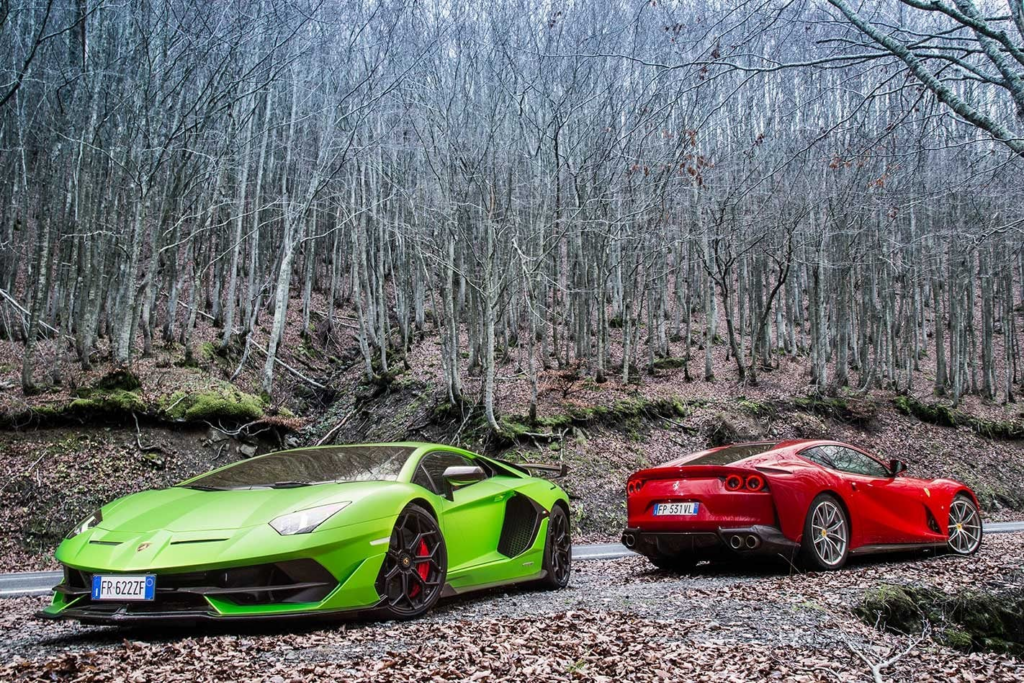
Ferrari, on the other hand, adheres to a more flowing, organic, and elegant design language. While Ferraris are undoubtedly aggressive and high-performance, their beauty lies in their sophisticated curves and aerodynamic efficiency. From the 288 GTO to the F8 Tributo and the 12Cilindri, Ferrari’s designs evoke a sense of timeless beauty and refined power.
Key design elements include:
Sculptural Lines: Ferrari’s designs are characterized by graceful, flowing lines that emphasize aerodynamics and aesthetic harmony.
Classic Proportions: The traditional front-engine, rear-wheel-drive layout of many Ferrari models allows for classic GT proportions and a sense of balance.
Race-Inspired Aesthetics: Ferrari’s design is often directly inspired by its racing heritage, resulting in functional beauty that is rooted in performance.
The Lamborghini vs. Ferrari design debate highlights a fundamental difference in philosophy. Lamborghini is the showman, the provocateur, the car designed to elicit gasps of awe. Ferrari is the silent assassin, the elegant predator that moves with precision, speed, and an understated confidence.
The Race That Never Was: Track Dominance vs. Road Supremacy
One of the most intriguing aspects of the Lamborghini vs. Ferrari rivalry is that despite the intense competition, the two brands have rarely faced off directly on the racetrack. This has not, however, diminished the rivalry. Instead, it has allowed each brand to forge its own unique identity and market position.
Ferrari: The Undisputed Track King
Ferrari’s dominance on the track is legendary. Scuderia Ferrari is the most successful team in the history of Formula 1, a testament to Enzo Ferrari’s unwavering commitment to racing. For Ferrari, the track is the ultimate proving ground. The lessons learned on the race circuit are directly translated to the road cars, ensuring that every Ferrari is a product of motorsport heritage.
Lamborghini: The Road Car Innovator
Lamborghini, by contrast, has always focused on building road-going supercars that excel in everyday performance and luxury. While Lamborghini has participated in various motorsport activities, it has never achieved the same level of track success as Ferrari. Instead, the brand has excelled in challenging the very definition