




Lamborghini vs. Ferrari: An Automotive Epic of Power, Ego, and Enduring Legacy
For generations, the world of luxury sports cars has been defined by a singular, electrifying rivalry. It’s a battle that transcends mere horsepower and engine displacement; it is a clash of philosophies, a war of pride, and a narrative that has sculpted the very definition of the modern supercar. We are talking, of course, about Lamborghini vs Ferrari. This is not simply a comparison between two Italian automotive giants; it is a deeply human story of raw ambition, relentless innovation, and the relentless pursuit of perfection that continues to push the boundaries of what a road car can achieve.
In the modern era of 2026, the landscape of this rivalry has evolved, incorporating hybrid technology and sustainable materials. However, the core principles remain steadfast: the primal roar of the engine, the visceral connection between driver and machine, and the undying passion for speed and performance. To understand Lamborghini vs Ferrari today is to understand the evolution of the supercar itself—a journey from analog rawness to digital precision, without sacrificing the soul that made these brands legendary.
The Genesis of Conflict: More Than Just a Disagreement
The origins of this monumental rivalry are steeped in drama and emotion. It began not on the racetrack, but in the workshop—the battlefield of the engineer. At the heart of the story is Ferruccio Lamborghini, the visionary founder of Automobili Lamborghini S.p.A. In the early 1960s, Lamborghini was a successful industrialist, renowned for his agricultural machinery and tractor manufacturing. His passion for performance cars led him to purchase several Ferraris, but he was far from satisfied.
Lamborghini’s frustration centered on the clutch mechanisms of the Ferrari models he owned. As an engineer and a man of immense pride, he believed he could improve upon the design. He decided to take his complaints directly to the source: Enzo Ferrari, the legendary founder of the Prancing Horse.
The encounter, as told in automotive lore, was decisive. Enzo Ferrari, a man who viewed his cars as extensions of his racing dynasty, dismissed Lamborghini’s technical critiques. He famously stated that a man who manufactured tractors had no business interfering with the engineering of a Ferrari. This was not just professional disagreement; it was a personal slight, an insult to Lamborghini’s mechanical expertise and his standing in the automotive world.
For a man like Ferruccio Lamborghini, this was a line crossed. His response was not one of acceptance but of defiance. Rather than wallow in indignation, he resolved to prove Enzo Ferrari wrong in the most definitive way possible: by building a superior automobile. This decision marked the birth of a new automotive superpower, one that would challenge the established king of Italian performance—Ferrari—on its own turf. The Lamborghini vs Ferrari debate began not with a product, but with a personal vendetta born of engineering pride.
Lamborghini’s Bold Challenge: An Icon Is Born
Ferruccio Lamborghini’s vision was ambitious from the outset. He did not set out to create mere fast cars; he sought to create a synthesis of speed, beauty, and everyday drivability. In 1963, his dream materialized with the launch of Automobili Lamborghini, a company established with the explicit goal of competing with the dominance of Ferrari in the high-performance market.
Lamborghini’s approach was revolutionary. While Enzo Ferrari focused on the raw, brutal efficiency of the racetrack, Ferruccio Lamborghini targeted the discerning luxury buyer who demanded performance without sacrificing comfort and style. The foundational philosophy was clear: a Ferrari was a machine to be raced, while a Lamborghini was a machine to be experienced.
This philosophical divergence laid the groundwork for the iconic Lamborghini Miura vs Ferrari Daytona showdown, a legendary battle that defined the early years of this rivalry.
The Miura vs. Daytona: A Revolution in Engineering
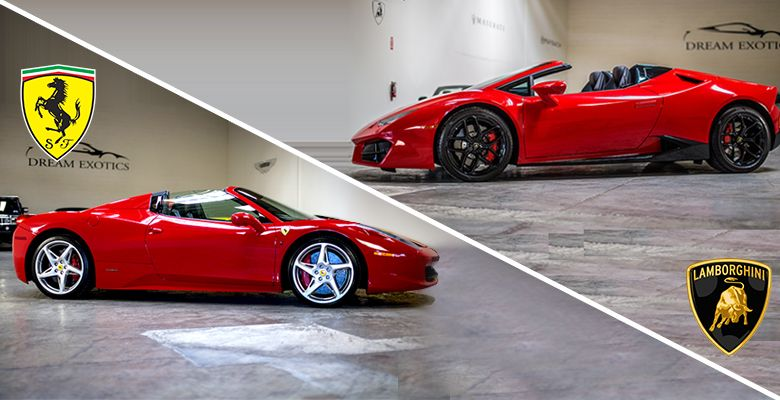
In 1966, the world witnessed the unveiling of the Lamborghini Miura—a car that was less a product and more a statement of intent. It was low, wide, and featured a groundbreaking mid-engine layout, placing the engine between the driver and the rear axle. This design not only improved weight distribution and handling but also created a stunning, exotic silhouette. The Miura was a rolling revolution, a car that redefined the supercar archetype with its dramatic aesthetics and radical engineering.
Ferrari, ever the custodian of tradition, responded with the 365 GTB/4 Daytona. While undeniably powerful and exhilarating, the Daytona maintained the conventional front-engine configuration, a nod to established racing heritage. This contrast between the radical, mid-engined Miura and the traditional, front-engined Daytona highlighted the fundamental differences between the two marques and set the stage for a decade-long technological and design competition.
The Miura’s legacy as a benchmark for supercar design cannot be overstated. It established the blueprint for the mid-engine configuration that would become the standard for high-performance vehicles. The Lamborghini Miura essentially invented the modern exotic supercar, forcing Ferrari to evolve or be left behind.
Clash of Design: Sharp Angles vs. Elegant Lines
The Lamborghini vs Ferrari debate extends beyond technical specifications to the very essence of aesthetics. The design philosophies of these two marques are diametrically opposed, creating a visual tension that appeals to different sensibilities.
Lamborghini: The Architecture of Aggression
Lamborghini’s design language is characterized by bold, angular lines that scream aggression and presence. Since the iconic Lamborghini Countach in the 1970s, the brand has embraced a sharp, dramatic, and almost futuristic aesthetic. Cars like the Aventador and the Huracán continue this tradition, featuring aggressive aerodynamic elements, sharp creases, and low-slung profiles that demand attention.
Look at the Aventador’s Lamborghini Aventador price or the Huracán’s Lamborghini Huracán performance specs—they embody the “shock and awe” approach. These are cars designed to look fast even when standing still. The aesthetic is unapologetically loud, mirroring the roar of the engine and the raw power under the hood. For the buyer who wants to make a statement and turn heads from miles away, Lamborghini is the definitive choice.
Ferrari: Precision, Elegance, and Speed
In contrast, Ferrari’s design language leans toward flowing lines, aerodynamic elegance, and sophisticated aggression. From the early 288 GTO to the modern F8 Tributo and 296 GTB, Ferrari’s cars exude grace and power in equal measure. The design is not about overwhelming presence but about precision, heritage, and the artistry of speed.
While the Ferrari Daytona established the benchmark for traditional design, modern Ferraris, such as the SF90 Stradale, blend cutting-edge aerodynamics with timeless Italian elegance. The Ferrari price reflects this focus on exclusivity and legacy. Ferrari’s aesthetic is that of a silent assassin—powerful, precise, and deadly effective. This contrast between the angular aggression of Lamborghini and the refined elegance of Ferrari forms the core of the Lamborghini vs Ferrari design debate.
The Race That Never Was: Track Prowess vs. Road Supremacy
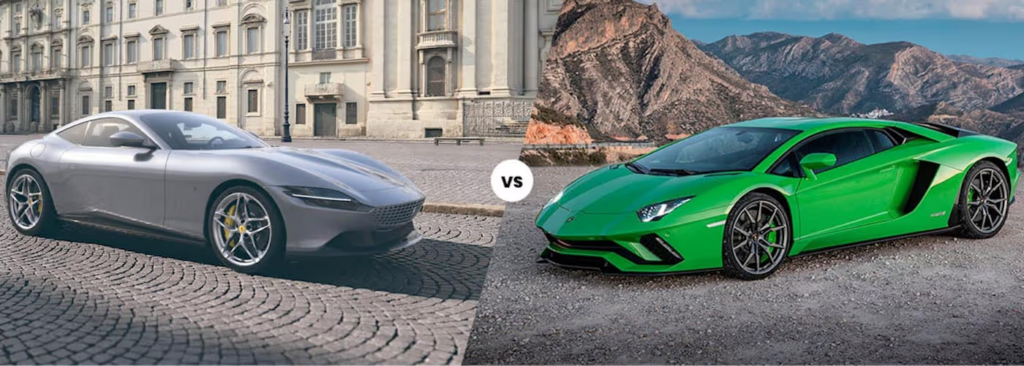
One of the most frequently asked questions about the Lamborghini vs Ferrari rivalry is whether these two titans have ever raced head-to-head. The technical answer is no—they have never competed directly on the racetrack in a formal capacity. However, this does not mean the rivalry has ended. It is a rivalry that manifests itself through technological innovation, customer loyalty, and performance dominance in different arenas.
Ferrari: The King of the Track
Ferrari has a deep-rooted history in motor racing, particularly in Formula 1. The Scuderia Ferrari team is the oldest and most successful constructor in Formula 1 history, with more championships and race wins than any other team. For a customer buying a Ferrari, they are not just buying a car; they are buying a legacy of racing heritage, precision engineering, and competitive spirit. The Ferrari Formula 1 team serves as the ultimate marketing tool, demonstrating the brand’s unwavering commitment to performance and excellence.
Lamborghini: The Street Conqueror
While Ferrari dominates the racetrack, Lamborghini has always aimed to manufacture luxury performance street cars. The company was built on a foundation of road cars, and its focus has historically been on delivering raw, exhilarating performance that can be enjoyed on the road. Lamborghini’s appeal lies in its unadulterated power and wild, exotic design.
Fact: Ferrari dominates the track, and Lamborghini rules the streets.
This distinction allows fans to choose their allegiance based on their personal priorities. Do you want to be part of a racing dynasty? Go for a Ferrari. Do you crave raw, uncompromising street performance and an aggressive aesthetic? Lamborghini is your choice.
Tech Rivalry: V12 Roars and Carbon Fiber Wars
The technological arms race between Lamborghini and Ferrari is the driving force behind their evolution. Both brands are constantly pushing the boundaries of what a car can be, with manufacturers investing heavily in hybrid supercar technology and electric sports car development.
Ferrari’s Hybrid Innovation
Ferrari has embraced hybridization to meet stringent emissions standards and enhance performance. The Ferrari SF90 Stradale, a plug-in hybrid supercar with 1,000 horsepower, utilizes cutting-edge electronics and race-car engineering to deliver breathtaking acceleration and handling. This car, with its advanced Ferrari SF90 Stradale price, represents the pinnacle of hybrid performance.
Lamborghini’s V12 Revolution
Lamborghini has also embraced hybrid technology while maintaining its signature V12 DNA. The Lamborghini Revuelto, a V12 hybrid that combines raw power with a dramatic design and frightening acceleration, demonstrates that sustainability does not mean boring. The Lamborghini