



Lambo vs. Ferrari: The Battle for the Soul of Italian Supercars
For decades, the whispered debate has echoed through garages, showrooms, and pit lanes: Lamborghini versus Ferrari. This isn’t just a comparison of two automotive titans; it’s a clash of wills, a war of ego, and a legacy built on speed, style, and sheer unadulterated passion. At the heart of this legendary rivalry lies a simple truth: it was born from a single spark of pride, fueled by relentless innovation, and forged in the crucible of competitive engineering. For those seeking the ultimate Italian supercar, the choice between these two marques represents more than just a preference for power or design—it is a decision that speaks to the very core of automotive philosophy.
In this comprehensive exploration, we delve into the epic saga of Lamborghini vs. Ferrari, dissecting the philosophies, technologies, and enduring appeal that have defined this iconic battle for supremacy. We examine how one man’s challenge forever altered the course of automotive history, creating a legacy of high-performance machinery that continues to captivate enthusiasts worldwide. This is not merely a recount of car comparisons; it is a narrative of automotive ideology, a story of how pride gave birth to innovation and how, through competition, two legendary brands were elevated to godlike status in the eyes of car lovers.
The Birth of a Rivalry: When Ego Met Excellence
The story of Lamborghini vs. Ferrari begins not on a racetrack, but in the workshop of a man driven by mechanical perfection and a refusal to be dismissed. In the early 1960s, Ferruccio Lamborghini, a successful tractor manufacturer, had a passion for high-performance automobiles. He owned several Ferraris, but his enthusiasm was tempered by persistent dissatisfaction, particularly concerning the car’s transmissions and clutch mechanisms. It was this technical frustration, coupled with a deep-seated pride, that would ignite one of the most famous rivalries in automotive history.
Lamborghini, ever the pragmatist, eventually decided to address his concerns directly with Enzo Ferrari. The legendary founder of Ferrari, known for his iron will and unwavering devotion to his brand, was not known for taking criticism lightly. The encounter, often romanticized, reportedly took place when Lamborghini attempted to approach Enzo with his technical complaints. In a now-infamous exchange, Enzo dismissed Lamborghini’s concerns, allegedly stating that a tractor driver could never truly appreciate the nuances of a Ferrari.
This dismissal became the catalyst. Ferruccio Lamborghini, stung by the implied insult and emboldened by his own engineering capabilities, decided that if Ferrari would not build the perfect road car, he would. Driven by the desire to prove his worth and challenge the reigning king of the Italian automobile market, he embarked on a mission to create a brand that would not only match Ferrari’s performance but eclipse it in terms of refinement and innovation. In 1963, Automobili Lamborghini was born, not as a competitor to Ferrari, but as a direct challenge to its legacy. This wasn’t just about building fast cars; it was about proving that a self-made man with engineering talent could outshine the established titan.
Lamborghini’s Bold Challenge to Ferrari
The birth of Automobili Lamborghini marked a turning point in the evolution of high-performance sports cars. Ferruccio’s vision was clear: he wanted to create vehicles that combined raw power with unprecedented luxury and refinement. He approached the challenge with a systematic and engineering-focused approach, hiring some of the best minds in the industry to build cars that would shatter the conventional norms of the era. The Lamborghini Miura vs. Ferrari Daytona battle that would soon ensue would showcase the stark differences in their philosophies.
While Ferrari’s heritage was deeply rooted in racing, Lamborghini’s focus was firmly on creating a road-going legend—a car that prioritized driver comfort and grand touring capability while still offering track-worthy performance. This approach fundamentally differentiated Lamborghini from its more motorsport-oriented competitors. The early success of Lamborghini vs. Ferrari was thus built on distinct identities, each appealing to a different type of enthusiast.
The 1960s were a golden era for automotive innovation, and Lamborghini wasted no time in making its mark. The Miura, launched in 1966, was a revelation. With its stunningly elegant design, aggressive stance, and radical mid-engine layout, the Miura was more than just a car—it was a statement. It introduced a design philosophy that would become the blueprint for supercar design for decades to come, challenging Ferrari to rethink its own approach to performance and aesthetics.
The Miura vs. Daytona: A Revolution in Motion
When the Lamborghini Miura was unveiled, the automotive world was captivated. It was an avant-garde masterpiece that redefined what a sports car could look like. With its low-slung profile, sharp angular lines, and aggressive stance, the Miura was unlike anything seen before. It wasn’t just beautiful; it was revolutionary. The Miura’s mid-engine layout allowed for perfect weight distribution and superior handling, a testament to Lamborghini’s commitment to engineering excellence.
Ferrari, unwilling to be overshadowed, responded with the Daytona. While the Daytona was a formidable machine with impressive performance, it represented a more traditional approach to supercar design. With its front-mounted engine and more classic silhouette, the Daytona embodied the established legacy of Lamborghini vs. Ferrari. The Miura, with its wild design and radical performance, pushed the boundaries of what was possible, while the Daytona held the line, representing the pinnacle of conventional engineering.
The Lamborghini Miura effectively set the stage for the future of high-performance motoring. Its revolutionary design and radical performance reshaped the supercar landscape, setting a precedent for innovation that would influence subsequent generations of automobiles. The Lamborghini vs. Ferrari rivalry had officially begun, not just on the track, but in the hearts and minds of enthusiasts worldwide.
Clash of Design: Sharp vs. Sleek
One of the defining aspects of the Lamborghini vs. Ferrari rivalry is the fundamental difference in their design philosophies. Lamborghini has long been associated with bold, aggressive, and futuristic aesthetics. The iconic Countach, Aventador, and Huracán models are testaments to this design language. Lamborghini cars are designed to be seen, to turn heads, and to elicit awe. They scream attention, much like a spaceship built for the future.
Ferrari, on the other hand, leans toward a more elegant and fluid design language. From the legendary 288 GTO to the modern F8 Tributo, Ferrari’s designs are a masterclass in sleek sophistication and controlled aggression. Ferrari cars are designed to be appreciated for their flowing lines, aerodynamic efficiency, and timeless beauty. They are the epitome of refined performance, subtle dominance that whispers power rather than shouts it.
In the design arena, Lamborghini is the show-off, the provocateur that challenges expectations with its audacious styling. Ferrari, in contrast, is the silent assassin—a predator that moves with grace and precision, delivering devastating performance without ostentatious display. This contrast in design aesthetics is a key reason why Lamborghini vs. Ferrari remains such a compelling topic of debate among enthusiasts and collectors.
The Race That Never Was: Track vs. Street
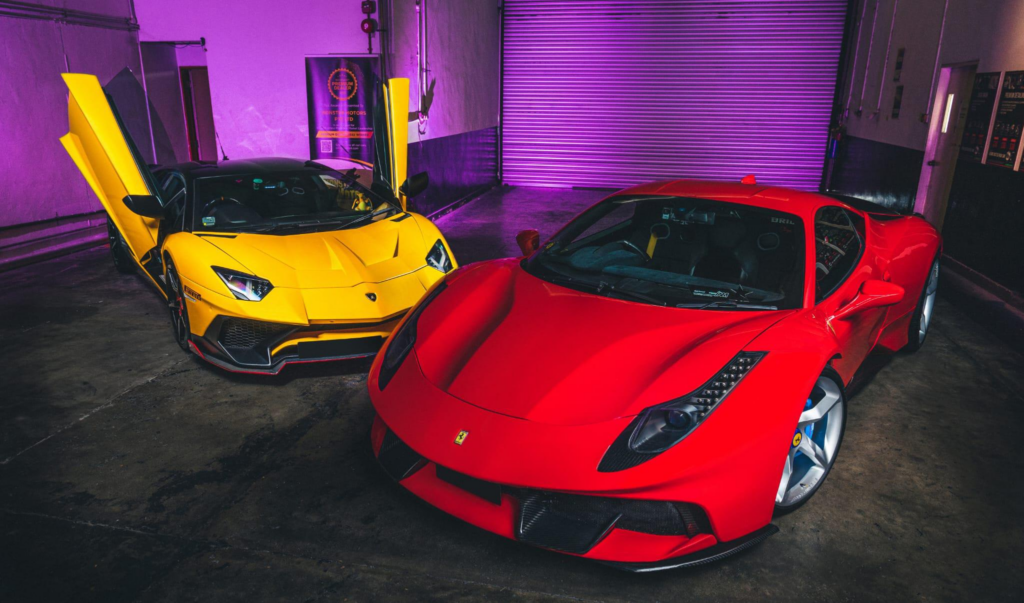
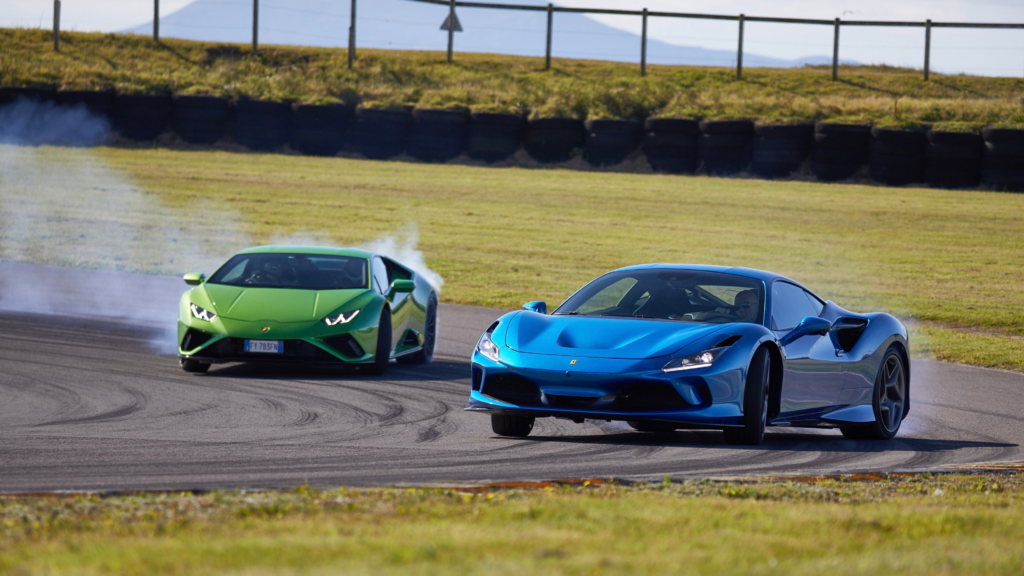
Although both brands have never faced off head-to-head on the racetrack, the Lamborghini vs. Ferrari rivalry is far from over. The competition continues to rage in the world of performance engineering, where both companies are constantly pushing the boundaries of speed and technology. However, one brand has always been associated with the world of Formula 1 racing, while the other has focused on creating luxury performance street cars.
Fact: Ferrari has dominated the racetrack for decades, while Lamborghini has always been the king of the streets. This difference in heritage and philosophy sets them apart, giving them distinct personalities in the automotive world. Whether you prefer the heritage of the track or the thrill of the street, the Lamborghini vs. Ferrari debate offers a choice for every type of enthusiast.
Tech Rivalry: V12 Roars and Carbon Fiber Wars
In the continuous race for automotive supremacy, both Lamborghini vs. Ferrari are forever testing the limits of what a car can achieve. They are engaged in a technological arms race to redefine speed, pushing the boundaries of performance through relentless innovation. The Ferrari SF90 Stradale stands as a testament to this commitment, featuring a 1,000-horsepower plug-in hybrid powertrain with advanced electronics and racecar-inspired handling.
On the other side, the Lamborghini Revuelto represents the pinnacle of hybrid performance and radical design. With its monstrous V12 engine and over-the-top styling, the Revuelto is a symphony of controlled chaos. The company constantly pushes the boundaries of what a car can be, with a relentless drive to achieve maximum performance while maintaining the iconic Lamborghini identity. This ongoing technological arms race ensures that the Lamborghini vs. Ferrari rivalry remains as compelling as ever, as each brand constantly seeks to outdo the other in terms of speed, power, and innovation.
Soundtrack of a Rivalry: Who Sounds Better?
For automotive enthusiasts, the soundtrack of a car is as important as its performance. The Lamborghini vs. Ferrari rivalry is defined by the distinct sound of their engines, each offering a unique auditory experience. Lamborghini’s V10 and V12 engines roar like lions in the jungle, their thunderous roars capable of being heard from miles away. These sound waves are powerful, aggressive, and visceral, delivering an immersive experience that captivates the senses.
Ferrari’s engines, on the other hand, produce a more refined and sophisticated sound. The Ferrari Italia and F40 selections produce a high-pitched sound like an opera, loud yet refined. Ferrari’s sound notes are higher in