




The Raging Bull vs. The Prancing Horse: A Deep Dive into Lamborghini vs. Ferrari
The automotive landscape is littered with legendary rivalries, but few ignite as much passion, debate, and sheer visceral emotion as the clash between Lamborghini vs. Ferrari. This is not merely a competition between two Italian supercar manufacturers; it is a battle of ideologies, a war of ego, and a perennial struggle for dominance in the hearts of enthusiasts worldwide.
The Genesis of a Legend: A Tale of Ego and Innovation
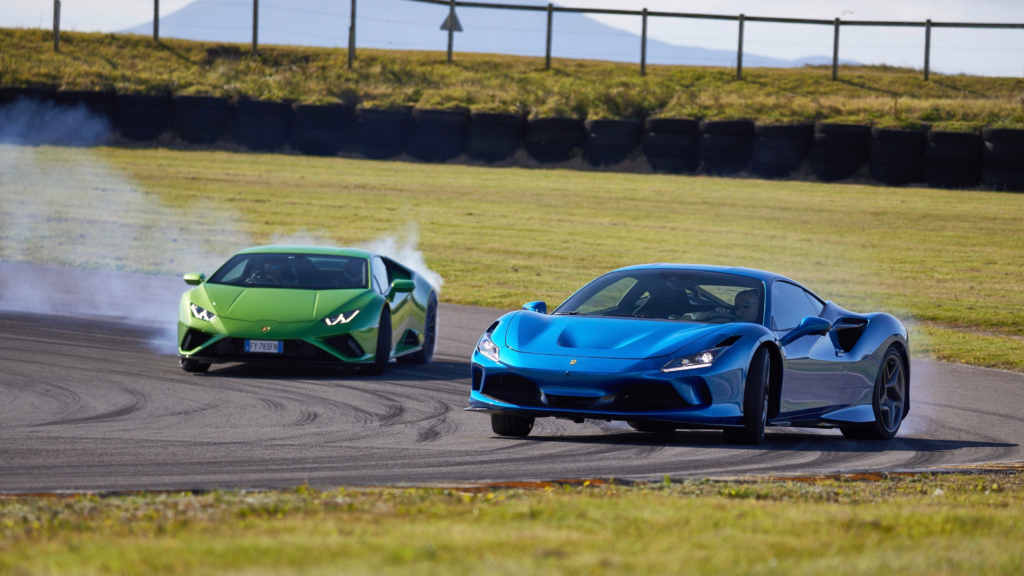
To truly understand the enduring rivalry of Lamborghini vs. Ferrari, one must venture back to the post-World War II economic boom of Italy. This era was defined by a burgeoning industrial spirit, characterized by mechanical ingenuity and a fierce sense of national pride.
At the helm of Ferrari stood Enzo Ferrari, a man whose personality was as legendary as the engines he built. A seasoned racer and an obsessive perfectionist, Enzo viewed his company as the ultimate expression of automotive engineering and performance. His philosophy was simple: race cars came first, and road cars were a necessary means to fund the racing endeavors. He often famously remarked, “You can drive a tractor, but you’ll never drive a Ferrari.” This sentiment was not just hubris; it was Enzo’s way of asserting that ownership of his cars was reserved for those who understood and appreciated the pinnacle of racing heritage.
Into this rarefied atmosphere stepped Ferruccio Lamborghini. Unlike Enzo, who was born into racing, Ferruccio was a man of the earth—literally. His empire was built on Lamborghini Trattori, a highly successful tractor manufacturing company. Ferruccio was a practical engineer, a man who understood the nuances of mechanical precision. He owned several Ferraris but remained perpetually dissatisfied, primarily due to what he considered inferior clutches.
Ferruccio was not one to suffer in silence. He took his concerns directly to Enzo Ferrari, expecting a professional and attentive response. Instead, he was met with disdain and dismissal. Enzo, viewing Ferruccio as nothing more than a tractor manufacturer, reportedly scoffed and told Ferruccio that he should stick to what he knew.
This dismissal was the catalyst that ignited one of history’s most iconic rivalries. Ferruccio Lamborghini, wounded by the arrogance of Enzo Ferrari, took the slight as a personal challenge. He decided that if the legendary Ferrari would not meet his standards, he would build a car that not only met but surpassed them.
In 1963, Automobili Lamborghini was officially founded. It was a declaration of war against the established titan. Ferruccio Lamborghini was not just looking to build fast cars; he sought to create automotive art that combined raw power with breathtaking beauty, everyday usability, and unparalleled luxury. The Lamborghini vs. Ferrari battle was no longer about two companies competing; it was about two competing visions of the automobile: Enzo’s racing dynasty versus Ferruccio’s revolutionary dream machine.
The First Shot: The Lamborghini Miura vs. The Ferrari Daytona
The world first witnessed the sheer audacity of the Lamborghini challenge in 1966 with the unveiling of the Miura. It was a car that shattered every conventional design mold. With its stunning low profile, impossibly wide stance, and revolutionary mid-engine layout, the Miura was a rolling revolution. It was designed by Marcello Gandini and its aggressive, angular lines foreshadowed the design language that would become synonymous with Lamborghini.
The Miura wasn’t just a visual spectacle; it was a mechanical masterpiece. Its transversely mounted V12 engine placed behind the driver provided optimal weight distribution, leading to handling dynamics previously only seen in race cars. It set a new benchmark for performance and design, proving that Ferruccio Lamborghini was not playing games.
In response, Enzo Ferrari and his team were forced to innovate rapidly. While the Miura was disrupting the supercar market, Ferrari was not standing still. They responded with the 365 GTB/4, soon to be known as the Daytona. Launched in 1968, the Daytona was the epitome of Ferrari performance. It featured a potent V12 engine mounted in the front, a design that emphasized its racing lineage. While it was incredibly fast and undeniably beautiful, it was fundamentally a evolution of existing design rather than the paradigm shift the Miura represented.
The Lamborghini Miura vs. Ferrari Daytona comparison was the first true chapter in the Lamborghini vs. Ferrari saga. It wasn’t just about who was faster; it was about who was pushing the boundaries of what a production car could be. The Miura proved that performance and stunning beauty could coexist, forcing Ferrari to reckon with a new competitor that threatened to dethrone the king. The die was cast, and the automotive world would never be the same.
The Clash of Design: Sharp Angles vs. Sculpted Elegance
While performance is the headline-grabbing aspect of the Lamborghini vs. Ferrari rivalry, the difference in their design philosophies is perhaps the most visually apparent. These two marques represent two distinct schools of automotive aesthetics, each with its own dedicated following.
Lamborghini, under the creative direction of Marcello Gandini and later Luc Donckerwolke, has always embraced an aggressive, angular, and futuristic aesthetic. Lamborghinis are designed to be seen. They scream for attention with sharp creases, dramatic intakes, and low, wedge-shaped profiles that look like they’ve been carved from a single block of titanium. Models like the Countach, Diablo, Aventador, and Revuelto are unapologetic in their visual aggression. They are often referred to as “supercar” designs, epitomizing raw power and futuristic styling. For many, a Lamborghini is the ultimate statement of bravado and exclusivity.
Ferrari, on the other hand, has historically leaned towards a more sculpted, fluid, and elegant design language. Their cars blend aerodynamic efficiency with sensual lines that speak of speed, passion, and sophistication. From the classic voluptuous curves of the 250 GTO to the refined aggression of the F8 Tributo, Ferrari designs are often described as more organic and seamlessly integrated. While they possess a raw power, it is often presented with an undercurrent of classic Italian beauty.
The comparison often boils down to this: Lamborghini is a spaceship—loud, brash, and futuristic. Ferrari is a silent assassin—elegant, precise, and deadly. Both brands produce breathtaking automobiles, but they cater to different emotional responses. The Lamborghini vs. Ferrari design debate is a testament to the fact that beauty is subjective, but both brands have managed to create iconic designs that define their respective legacies.
The Race Track vs. The Street: Different Battlegrounds, Same War
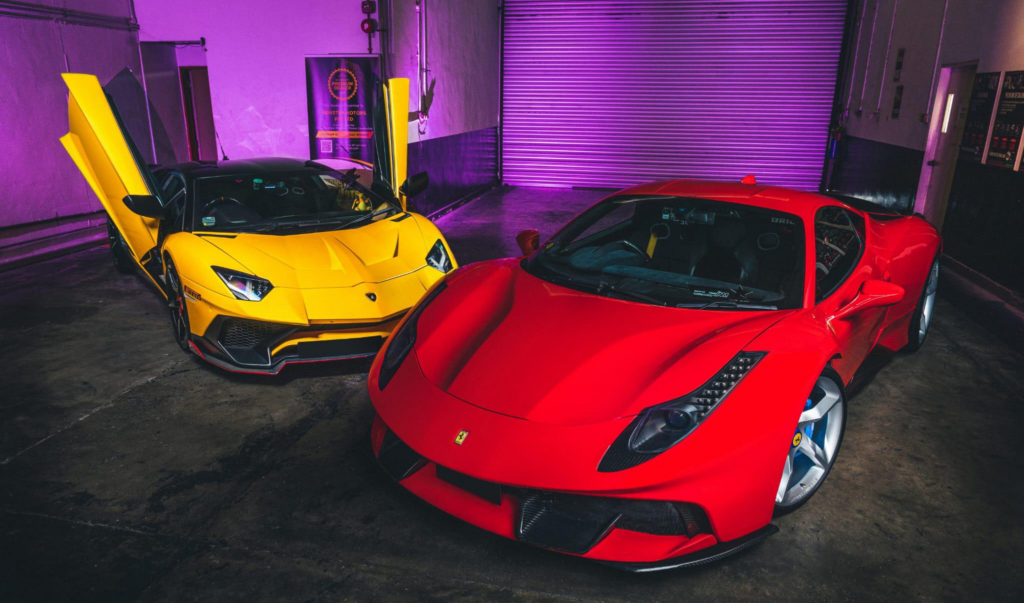
Although Lamborghini vs. Ferrari is often perceived as a direct competition, it is important to understand that the two brands have historically occupied different niches in the automotive market.
Ferrari has always been and continues to be a dominant force in motorsports. The company was founded on racing, and its Formula 1 team remains one of the most iconic and storied franchises in global sports. Every road-going Ferrari car benefits from the advanced technology, aerodynamic insights, and engine expertise developed on the track. The legacy of drivers like Juan Manuel Fangio, Niki Lauda, and Michael Schumacher is inextricably linked to the Ferrari brand, giving their road cars a pedigree that is unmatched in the industry. Owning a Ferrari is not just about owning a fast car; it is about becoming part of a dynasty.
Lamborghini, conversely, has historically focused on the street. While they have participated in various forms of racing, their primary objective has always been to build high-performance, road-legal supercars that redefine automotive standards. Ferruccio Lamborghini was a road car man, and his vision was to create cars that would stun on the street, even if Enzo Ferrari preferred the track.
However, as the automotive landscape evolves, these lines have begun to blur. Lamborghini has become increasingly involved in motorsports, and Ferrari has sought to broaden its market appeal by producing more versatile and everyday-friendly performance cars, such as the Urus and the Purosangue. The Lamborghini vs. Ferrari rivalry is no longer confined to specific market segments; it now encompasses every aspect of the automotive world.
The Heart of the Engine: V12 Roars and Carbon Fiber Wars
The defining characteristic of any Lamborghini or Ferrari is its engine. These brands have long been pushing the boundaries of internal combustion technology, often in a relentless pursuit of raw power and breathtaking performance.
Historically, Ferrari has been known for its soulful, naturally aspirated V12 engines. The roar of a classic Ferrari V12 is often described as a symphony—an escalating, high-pitched wail that builds to a crescendo as the engine screams towards the redline. Models like the 458 Italia, F40, and the 812 Superfast exemplify this legacy.
Lamborghini, too, is a master of the V12, but their approach is more about raw brute force and aggression. The Lamborghini V12 is often characterized as a guttural, earth-shattering roar that is as intimidating as it is exhilarating. The engines in the Aventador and the new Revuelto are designed to shock and awe, with a power delivery that is immediate and uncompromising.
However, the Lamborghini vs. Ferrari rivalry has also extended into the realm of technological innovation. Both brands are now engaged in the transition to hybrid and electric powertrains, a shift that represents the biggest technological challenge in their history. Ferrari