
2026 Toyota Camry Expert Review
America’s best-selling passenger car received a full-scale reinvention just last year, meaning the changes for the 2026 Toyota Camry are modest—centered around a new special-edition model and available exterior paint colors. With its striking, modern redesign and redesigned interior, the ninth-generation Camry adopts a standard hybrid powertrain across the entire lineup, offering both front- and all-wheel-drive configurations.
With a dual personality that caters to drivers seeking comfort or sport-tuned performance, it’s unsurprising that the Camry remains the preferred choice for countless new-car buyers annually. Key competitors in the shrinking but ultra-competitive midsize sedan segment include the Honda Accord, Hyundai Sonata, and Nissan Altima.
What’s New for 2026
Just one year after a significant redesign, the 2026 Camry sees only a couple of updates designed to keep the momentum going:
Nightshade Edition: This specialized trim blacks out the badging and specific trim pieces, and features distinctive black 19-inch wheels.
Dark Cosmos: A new deep blue paint color has been introduced for 2026, offered on SE, XLE, and XSE trims.
For 2025, the midsize sedan underwent a comprehensive overhaul, establishing the foundation for the 2026 model year.
Performance & Powertrain
For 2026, the midsize sedan retains the revolutionary hybrid powertrain that debuted in the 2025 model. This setup unites a 2.5-liter four-cylinder engine with a sophisticated electric motor system.
The standard front-wheel-drive configuration delivers a combined output of 225 horsepower. Buyers seeking enhanced traction and improved acceleration can opt for the all-wheel-drive system, which incorporates a third electric motor powering the rear wheels when needed. AWD versions boost the total output to 232 horsepower.
When equipped with front-wheel drive, the Camry achieves a 0–60 mph time of approximately 6.9 seconds. All-wheel-drive variants shave off a fraction of a second, hitting 60 mph in just 6.8 seconds. Under normal driving conditions, the Camry provides more than sufficient passing power, making confident maneuvers on highways and city streets easy.
Performance Comparison: Camry vs. Rivals
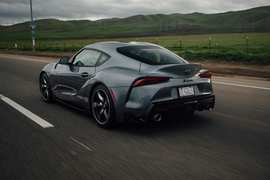
When pitted against its contemporary rivals, the Camry stands out for its dynamic driving capabilities.
| Vehicle | Powertrain | 0–60 mph (Seconds) | Horsepower | Drivetrain |
| :— | :— | :— | :— | :— |
| 2026 Toyota Camry | Hybrid | 6.8–6.9 | 225–232 | FWD / AWD |
| 2025 Honda Accord | Hybrid | 6.6 | 204 | FWD |
| 2025 Honda Accord | Non-Hybrid | 7.9 | 192 | FWD |
| 2025 Kia K5 | 1.6L Turbo | 7.1 | 180 | FWD |
| 2025 Nissan Altima | Non-Hybrid | 7.9 | 188 | FWD / AWD |
Source: Manufacturer specs, testing results
As you can see, the 2026 Camry Hybrid easily outperforms the non-hybrid Accord and Altima in acceleration, while matching the sportiest Honda Accord Hybrid. In our real-world testing, we were particularly impressed with the Camry’s responsive steering, linear braking feel, and remarkable chassis control, which provides a composed and planted ride.
MPG & Fuel Economy
Fuel economy is a standout strength of the entire 2026 Toyota Camry lineup, building on the exceptional EPA ratings established for the 2025 models. Mileage varies depending on the trim level and drivetrain configuration.
The most efficient configuration is the front-wheel-drive LE model, delivering an impressive 53 mpg in the city and 50 mpg on the highway. When all-wheel drive is selected, the efficiency drops slightly to 51 mpg city / 49 mpg highway.
For the remaining trims, the EPA estimates vary within the following ranges:
Front-Wheel Drive (FWD): 48–51 mpg city / 47–49 mpg highway
All-Wheel Drive (AWD): 44–46 mpg city / 43–46 mpg highway
These figures demonstrate the significant advantage the Camry offers over traditional gasoline sedans. In an era of fluctuating fuel costs, owning a Camry means spending significantly less at the pump, providing substantial savings over the life of the vehicle.
Toyota Camry vs. Its Rivals: A Deep Dive
When we tested the 2025 Camry against its primary competitors, the Toyota Camry emerged as the winner. Our comprehensive evaluation included the Kia K5, Honda Accord, and Hyundai Sonata, all priced under $40,000.
Kia K5: Stylized but Limited
The Kia K5 commands attention with its striking exterior design and a generous list of standard features, along with excellent passenger and cargo volume. However, its driving experience leaves much to be desired. The transmission is notably slow to react, and the standard engine produces an unrefined drone when pushed. While it offers style and space, it lacks the refinement and engagement of the Camry.
Honda Accord: Refined but Pricy
The Honda Accord is a strong contender, boasting a sophisticated and refined driving experience. However, it notably lacks an all-wheel-drive option, limiting its versatility in varied climates. The pricing structure can be a deterrent, especially as you move up the trim range, and we’ve also found its lane-keeping assist system to be less reliable than many competitors, which can create safety concerns.
Hyundai Sonata: Comfortable but Underpowered

The Hyundai Sonata offers a relaxing, comfortable ride and consistent braking performance, complemented by a robust standard equipment package. Nevertheless, its powertrain feels underpowered for the size of the vehicle, and it decidedly lacks the sportiness that modern drivers increasingly demand.
The Verdict: Camry Reigns Supreme
These comparisons highlight why the Toyota Camry consistently comes out on top. The all-hybrid lineup delivers outstanding fuel efficiency without sacrificing driving enjoyment. While the interior might feel a bit snug for some passengers and the ride quality leans toward the firm side, the Camry feels like a thoroughly modern midsize sedan operating at the peak of its game.
Safety Ratings & Features
The 2025 Toyota Camry earned strong safety scores, and we expect the 2026 model to achieve similar results. The Insurance Institute for Highway Safety (IIHS) named the 2025 Camry a Top Safety Pick+, the organization’s highest accolade.
The Toyota Safety Sense 3.0 suite of driver-assistance technology comes standard on all trims. This comprehensive system includes:
Pre-Collision System with Pedestrian Detection: Automatically warns of impending frontal collisions and can apply brakes if the driver fails to respond.
Automatic Emergency Braking: Detects pedestrians and cyclists and engages the brakes to prevent or mitigate impacts.
Full-Speed Range Dynamic Radar Cruise Control: Maintains a set distance from the vehicle ahead, allowing for relaxed driving in traffic.
Lane Departure Alert with Steering Assist: Warns the driver if the vehicle begins to drift out of its lane and can provide gentle steering correction.
Lane Tracing Assist: Keeps the vehicle centered in its lane, working in conjunction with cruise control.
Road Sign Assist: Identifies road signs and displays them on the driver’s information screen.
Automatic High Beams: Automatically switches between high and low beams to improve visibility.
Toyota also equips the Camry with Proactive Driving Assist, a system that provides small braking and steering inputs to maintain safe distances from other vehicles, bicyclists, and pedestrians, as well as gentle braking into curves.
Additional standard safety features include Blind Spot Monitoring and Rear Cross-Traffic Alert.
For those seeking maximum safety and convenience, the top-tier XLE and XSE trims offer the Premium Plus Package. This comprehensive upgrade equips the Camry with:
Traffic Jam Assist: Provides partial automation in slow-moving traffic (available when the vehicle is properly equipped).
Front Cross-Traffic Alert: Warns the driver of oncoming traffic when pulling out of an intersection or parking space.
Lane Change Assist: Helps the driver execute safe lane changes.
360-Degree Camera System: Provides a bird’s-eye view of the vehicle’s surroundings.
Front and Rear Parking Assist with Automatic Braking: Helps prevent low-speed parking collisions.
Cargo Space & Interior Room
When evaluating passenger comfort and practicality, the 2026 Toyota Camry offers a solid balance of space and utility, although some rivals provide marginally more room.
Legroom (Front/Rear)
| Vehicle | Front Legroom | Rear Legroom |
| :— | :— | :— |
| 2026 Toyota Camry | 42.1 inches | 38.0 inches |
| 2025 Hyundai Sonata | 46.1 inches | 34.8 inches |

| 2025 Honda Accord | 42.3 inches | 40.8