




The Raging Bull vs. the Prancing Horse: An Enduring Legacy of Competition
For decades, the automotive world has been captivated by one of the most storied rivalries in history: Lamborghini vs Ferrari. This isn’t merely a comparison of two prestigious Italian car manufacturers; it is a legendary clash of ego, innovation, and uncompromising vision. The genesis of this rivalry is etched into the annals of automotive lore, a tale of personal slight transformed into a global competition that has defined the very concept of the supercar. To understand Lamborghini vs Ferrari is to understand the raw, human ambition that drives technological evolution and the eternal pursuit of perfection.
The story begins not with a blueprint, but with a confrontation. In the early 1960s, Ferruccio Lamborghini, a successful industrialist and a proud owner of several Ferrari automobiles, found himself increasingly dissatisfied with the performance and reliability of his vehicles. Unlike most discerning customers, Lamborghini possessed a formidable technical mind and an equally formidable temper. His primary complaint centered on the clutch system of his Ferraris, which he found inadequate for the demands of high-performance motoring.
Frustrated, Lamborghini decided to approach Enzo Ferrari directly. His intention was not to demand attention, but to offer constructive criticism. He believed that his insights, based on his own engineering experience, could improve the very cars that bore the prancing horse emblem. However, what transpired in that meeting would forever alter the course of both companies.
Enzo Ferrari, the legendary figurehead of the marque, was not known for his humility. He viewed Lamborghini not as a peer or a potential collaborator, but as an intruder—a man from the world of agriculture daring to criticize the master of automotive engineering. The encounter reportedly ended with Enzo dismissing Lamborghini with a sneering remark, questioning his right to judge a Ferrari when he was merely a tractor manufacturer. The precise wording varies depending on the source, but the sentiment was clear: Lamborghini was not welcome in Ferrari’s exclusive circle.
This dismissal, fueled by pure pride and arrogance, was the catalyst that ignited the firestorm. Ferruccio Lamborghini, having been insulted by the man he considered his peer, was galvanized into action. He resolved to build a car that would not only match but surpass Ferrari’s creations. He sought to demonstrate that his engineering prowess was equal to, if not superior than, Enzo’s. This personal vendetta would ultimately lead to the birth of Automobili Lamborghini.
The objective was clear: to create a supercar that combined the raw, visceral performance of a race car with the refinement, luxury, and comfort expected of a grand touring vehicle. Lamborghini’s vision was to create a machine that was as beautiful to behold as it was breathtaking to drive. In 1963, the vision materialized into reality with the unveiling of the Lamborghini 350 GT. This was not just another luxury car; it was a declaration of war. The stage was set for one of the most iconic battles in automotive history, the Lamborghini vs Ferrari rivalry that would shape the future of high-performance motoring.
The Genesis of the Rivalry: From Motorway Frustration to Automotive Epic

The story of Lamborghini vs Ferrari is fundamentally a tale of ego clashing with ambition, a narrative that resonates far beyond the gleaming showroom floors of Maranello and Sant’Agata Bolognese. While the legendary rivalry took years to fully manifest its spectacular intensity, the seeds of competition were sown during a pivotal period in the early 1960s.
During this era, Ferrari dominated the landscape of high-performance automobiles with an almost unchallenged authority. However, the automotive world was on the cusp of a seismic shift. The demands of the road were evolving, and a new generation of drivers was beginning to yearn for something more than just speed. They desired vehicles that were not just fast but also beautiful, comfortable, and aesthetically striking. It was within this transitional period that the trajectory of Lamborghini vs Ferrari was forever altered.
Ferruccio Lamborghini, a man of formidable engineering talent, was an early adopter of the cutting-edge technology available at the time. He owned several Ferraris, including the famed 250 GT models. While he respected the engineering prowess of Ferrari, he felt a growing frustration with certain aspects of the cars’ design and functionality. His most significant grievance, and one often cited in the legends of this rivalry, pertained to the car’s gearbox and clutch system. Lamborghini found these components to be overly fragile and impractical for daily driving, often experiencing issues that tarnished the overall driving experience.
In the traditional hierarchy of the automotive world at the time, owners were expected to remain silent and accept the products of established manufacturers. However, Ferruccio Lamborghini was not one to adhere to convention. He decided to address his concerns directly with Enzo Ferrari himself. This decision was a bold move, as Ferrari was known for his unyielding pride and his intolerance of criticism, particularly from those outside the inner circle of racing enthusiasts.
The meeting between Lamborghini and Ferrari is a moment forever enshrined in automotive folklore. The specifics of the conversation are often embellished in the retelling, but the core of the encounter is consistent. Lamborghini reportedly presented Enzo with a detailed analysis of the flaws in his Ferrari cars, suggesting specific improvements. Instead of engaging with these technical points, Enzo Ferrari reacted with characteristic arrogance. He famously dismissed Lamborghini, declaring that a man who drives a tractor would never know how to drive a Ferrari.
This dismissal was more than just a slight; it was a profound insult that struck at the heart of Lamborghini’s pride as a fellow engineer and entrepreneur. The message was clear: Ferrari would not tolerate criticism, and Lamborghini was not worthy of comment.
For Lamborghini, this rejection was the final straw. He was not deterred by the insult; instead, he was invigorated by it. He resolved that if Ferrari would not listen to his concerns, he would build a car that proved him right. He decided to create a brand that would challenge Ferrari’s dominance by offering a superior alternative. This resolve led to the establishment of Automobili Lamborghini in 1963. His goal was not merely to compete, but to fundamentally change the definition of a high-performance car by blending raw power with elegant design and technological innovation.
The Miura Revolution: Setting the Standard for the Supercar Era
The simmering rivalry between Lamborghini vs Ferrari finally erupted onto the public stage in the mid-1960s with the launch of the Lamborghini Miura. This vehicle was not merely an incremental improvement on existing sports cars; it was a paradigm shift in automotive design. The Miura was a radical departure from the traditional front-engined, rear-wheel-drive layout that had dominated the market. It featured a mid-engine configuration, a design that was revolutionary at the time, positioning the engine between the cabin and the rear axle.
The Miura was a stunning creation. Its design was both functional and aesthetically breathtaking, characterized by its low stance, flowing curves, and aggressive profile. The car was a masterclass in aerodynamic engineering, featuring a monocoque chassis and independent suspension that provided exceptional handling and stability at high speeds. Under the hood, the Miura housed a powerful V12 engine that produced a staggering amount of horsepower, allowing the car to achieve speeds that were previously unimaginable for road-going vehicles.
The launch of the Miura at the 1966 Geneva Motor Show was a sensation. The world had never seen anything like it. The car was universally acclaimed by critics and collectors alike, and it quickly became a symbol of prestige, wealth, and cutting-edge technology. The Miura was not just a car; it was a rolling revolution that set a new standard for the supercar market.
Ferrari, although initially dismissive of Lamborghini, could not ignore the impact of the Miura. The car was a clear challenge to Ferrari’s dominance, and the company felt compelled to respond. In 1967, Ferrari launched the 365 GTB/4 Daytona, a powerful grand touring car that was designed to compete directly with the Miura. The Daytona was a worthy successor to the legendary 275 GTB, and it quickly became one of the most sought-after cars in the world.
However, the Daytona was still a front-engined car, maintaining the traditional layout that Lamborghini had rejected. This fundamental difference in design philosophy was a clear representation of the ideological divide between the two manufacturers. Ferrari remained anchored in tradition, while Lamborghini embraced innovation and pushed the boundaries of what was thought possible.
The Miura was not just a technological achievement; it was a cultural phenomenon. The car became synonymous with glamour, speed, and luxury, and it quickly became one of the most desirable cars in the world. The Miura’s impact was felt across the globe, with collectors and enthusiasts alike clamoring to get their hands on this iconic machine. The car’s legacy continues to this day, with the Lamborghini Miura regarded as one of the most important and influential automobiles ever created. It was the Miura that truly ignited the Lamborghini vs Ferrari rivalry, setting the stage for a long and passionate competition that has captivated car enthusiasts for decades.
A Clash of Design Philosophies: From Angular Aggression to Elegant Curves
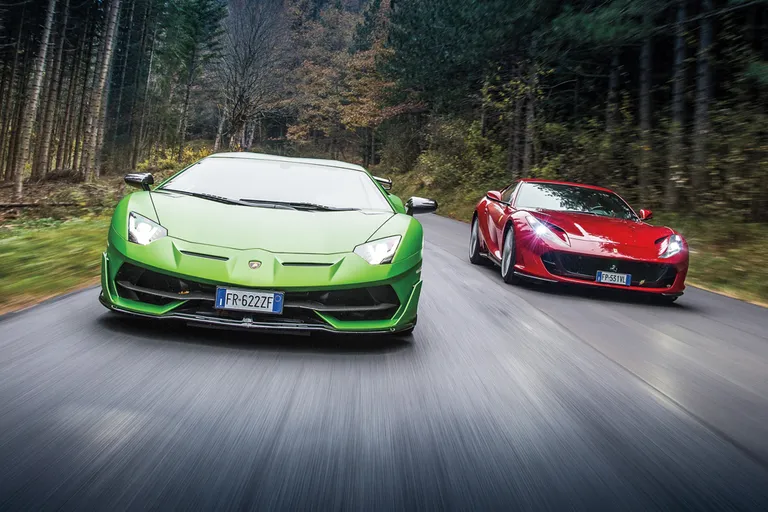
The rivalry between Lamborghini vs Ferrari is not solely defined by technical specifications or lap times; it is also a profound clash of aesthetic philosophies. For the discerning enthusiast, the visual language of these two brands speaks volumes about their respective identities and approaches to automotive design. These differing philosophies have shaped the very soul of the supercar genre, each offering a unique interpretation of automotive beauty and aggression.
Lamborghini has consistently embraced a design philosophy that can best be described as avant-garde, radical, and often futuristic. From the very early days of the Miura to the angular menace of the Countach and the modern sharpness of the Aventador and