




Lamborghini vs. Ferrari: A 60-Year War of Engineering, Ego, and Legacy
The roar of a naturally aspirated V12 against the shriek of a high-revving V8. The razor-sharp lines of a Countach challenging the sculpted curves of a Daytona. For six decades, the rivalry between Lamborghini and Ferrari has defined the very essence of the exotic supercar. It’s a conflict that transcends mere automotive engineering—it is a visceral battle of personalities, design philosophies, and market dominance that continues to shape the luxury automotive landscape today.
The Birth of the Bull: A Tractor Tycoon’s Vengeance
The tale of these automotive titans begins not in a high-stakes auction or a Grand Prix victory, but with a broken clutch in a Ferrari 250 GT. The protagonist? Ferruccio Lamborghini, a man already legendary in his own right as a pioneer in Italian agricultural machinery. Lamborghini’s success with tractors provided him not only with the wealth to indulge his passion for grand tourers but also with a pragmatic, engineering-first mindset.
By the early 1960s, Lamborghini possessed a collection of elite vehicles, including several Ferraris. However, the celebrated Cavallino Rampante was not flawless in his eyes. Lamborghini found the transmission, and specifically the clutch, to be brittle and prone to failure—an unacceptable flaw in his view of performance engineering. He decided to present his concerns directly to Enzo Ferrari himself.
The interaction that followed is legendary. Enzo Ferrari, a man notoriously dismissive of feedback, particularly from those outside the world of motorsport, reportedly told Lamborghini that while he could drive a tractor, he would never know how to drive a Ferrari. This insult, rooted in professional pride and class distinction, became the catalyst. Ferruccio Lamborghini, fueled by wounded pride, decided that if Ferrari could not build a machine of perfect mechanical integrity, he would.
In 1963, Automobili Lamborghini officially began production in Sant’Agata Bolognese. Unlike Ferrari, whose legacy was forged on the race track, Ferruccio’s vision was unapologetically road-focused. He aimed to create a grand tourer that offered the performance of a sports car with the comfort and usability of a luxury GT—a superior machine designed to eclipse Ferrari.
Enzo Ferrari: The Master Strategist of the Prancing Horse
Enzo Ferrari, born in 1898, was an Italian racing driver and automotive entrepreneur. His career began with Scuderia Ferrari in 1929, and his obsession with racing became the driving force behind the company. Enzo believed that race cars were the lifeblood of the brand; every road car produced served as a means to fund his true passion: Formula 1.
Enzo’s leadership was authoritarian and uncompromising. His philosophy was simple: speed, power, and uncompromising performance. His engineers were instructed to build fast cars, and the brand’s mystique was sustained by its winning record on the track. This singular focus on motorsport success bred a culture where the road car was a product of racing necessity, rather than a standalone object of desire.
Ferruccio Lamborghini: The Pragmatic Innovator
Ferruccio Lamborghini, born in 1916, brought a different perspective to the automotive world. As a successful industrialist, he approached engineering from a practical standpoint. He didn’t just want to go fast; he wanted to build something better, more reliable, and more luxurious than what already existed. His experience with tractors gave him a deep understanding of transmissions and mechanics, which informed his approach to car design.
Lamborghini’s success was a testament to his ability to disrupt established industries. By applying his engineering principles to automotive design, he created a new category of vehicle—one that combined performance with comfort, challenge, and undeniable style.
The Ultimate Showdown: Miura vs. Daytona
The automotive world truly understood the depth of this rivalry in 1966 with the introduction of the Lamborghini Miura. The Miura was a seismic event in automotive design. Its revolutionary mid-engine layout, designed by a young Marcello Gandini, pushed the boundaries of what was considered possible in performance car engineering. The Miura was wide, aggressive, and unlike anything the world had ever seen.
Ferrari did not stand still. In response, they introduced the Ferrari 365 GTB/4 Daytona. While fast and aggressive, it adhered to the traditional front-engine, rear-wheel-drive layout, marking a philosophical divergence between the two brands. Where Lamborghini was disruptive and radical, Ferrari was evolutionary and refined, sticking to a proven formula while pushing its limits.
The Miura set the stage for modern hypercars. Its mid-engine layout became the standard for high-performance supercars. It was not just a car; it was a rolling statement that redefined automotive performance and design.
A Clash of Design Ideologies
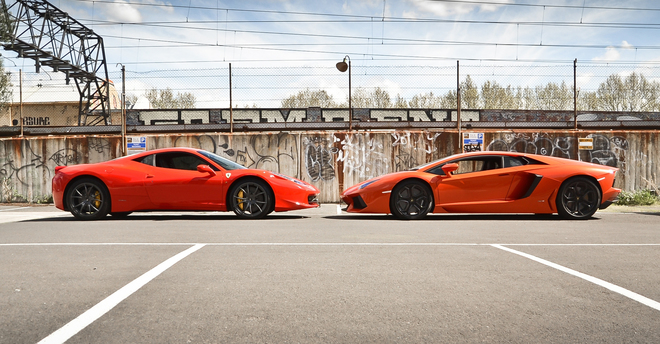
Lamborghini vs. Ferrari isn’t just about speed; it’s a battle of design philosophies. Lamborghini’s design language is bold, angular, and aggressive—cars that scream for attention. Look at the Countach, the Aventador, the Huracán. These vehicles are designed to provoke a reaction. Ferrari, conversely, focuses on flowing lines and elegant aggression. From the 288 GTO to the F8 Tributo, Ferrari’s design is about sleek dominance.
Lamborghini: Shock and awe, raw power.
Ferrari: Grace and aggression, precise engineering.
The Race That Never Was: Track vs. Street
While Lamborghini and Ferrari never faced off head-to-head on the race track, the rivalry remains fiercely competitive on the road. For years, Ferrari has been the undisputed master of motorsport, winning an unparalleled record number of Formula 1 championships. Their heritage is fundamentally tied to racing, and every road car sold is seen as a contribution to their racing program.
Lamborghini, on the other hand, has historically focused on manufacturing luxury performance street cars. Their priority has been to create the fastest, most exclusive road vehicles available, rather than competing in motorsport. While the brand has dabbled in racing, its primary focus remains on producing machines that command attention on the road.
Fact: Ferrari dominates the track; Lamborghini rules the street.
Technological Evolution: From V12 Roars to Carbon Fiber Wars
Both brands are constantly pushing the boundaries of what a car can be. Ferrari introduced the SF90 Stradale, a 1,000-horsepower plug-in hybrid supercar with advanced electronics and racing-derived hardware. Lamborghini responded with the Revuelto, a hybrid V12 with an extravagant design and breathtaking acceleration. The companies are engaged in an automotive arms race, redefining the limits of speed and performance.
You are likely wondering, which one is a better option? For Lamborghini, if you desire wild designs and powerful street performance, their bolder approach might be your best bet. Conversely, if you seek the heritage of racing excellence with elegance and refined engineering, Ferrari is the superior choice.
Case Study: The Lamborghini Miura Owner
Consider a case study from 1967: an engineer from Lamborghini’s production team purchased one of the first Miuras. After a thousand miles, he realized that while the performance was astounding, the gearbox was a constant frustration. He eventually dismantled the gearbox, redesigned it to incorporate synchronous meshing—an innovation from their tractor business—and rebuilt it. The car performed even better. This demonstrates Lamborghini’s commitment to practical engineering and improvement, even within their own lineup.
The Sound of a Rivalry: Who Sounds Better?
For automotive enthusiasts, the debate over which brand sounds better is a recurring topic.
The V10 and V12 engines of a Huracán or Aventador roar like a lion in the jungle, the sound audible for kilometers. These engines emit loud, powerful notes. By contrast, Ferraris like the Italia or the F40 produce a higher-pitched, precise shriek—a symphony of high-frequency vibrations. Lamborghini’s sound waves shake the earth; Ferrari’s are the silent predator you don’t hear until it’s too late.
There is no definitive winner. Each brand offers a distinct auditory experience. Some prefer the raw power of a Lamborghini, while others favor the refined engineering and precise acoustics of a Ferrari.
Cost Breakdown: Investing in Performance
If you are considering owning either of these icons, understanding the pricing structure is crucial. Purchasing a Ferrari or a Lamborghini is more than just a transaction; it involves becoming part of an exclusive world.
Ferrari Ownership: To own a Ferrari, particularly special models like the LaFerrari, one must “earn” the right through loyalty to the brand. This commitment often requires purchasing multiple vehicles before gaining access to exclusive models.
Lamborghini Ownership: Lamborghini is more accessible in terms of access. Anyone with sufficient funds can purchase a Lamborghini without the same level of gatekeeping.
If you want to experience the royalty and legacy of motorsport, go for a Ferrari. If you simply want to grab attention from kilometers away with the flames coming out of the exhaust, Lamborghini is your choice.
New Competitors in a Changing Era
In the current era of electrification, both brands are adapting without losing their identity.
Upcoming Lamborghini Cars in 2026:
Revuelto PHEV V12: Starting around $600,000
Huracán Replacement (Hybrid): Expected price around $270,000
Urus PHEV: Starting around $240,000
Upcoming Ferrari Cars in 2026:
12Cilindri Spider: Expected price around $420,000
SF90 Spider: Starting around $5