




Lamborghini vs Ferrari: The 75-Year Rivalry That Reshaped the World of Exotic Cars
For nearly three-quarters of a century, the names Lamborghini and Ferrari have been more than just automotive labels; they represent opposing philosophies, raw emotion, and the unbridled pursuit of automotive perfection. Since the seismic 1963 debut of Automobili Lamborghini, the rivalry between the raging bull and the prancing horse has been the defining narrative of the supercar genre.
This rivalry, however, is not merely a story of different engineering approaches; it is a deep-seated ideological conflict that spans performance, design, heritage, and market positioning. To understand the difference between Lamborghini and Ferrari is to understand the fundamental split between extreme, aggressive performance and refined, race-proven heritage.
As an automotive industry veteran with over a decade of experience tracking technological advancements and market dynamics, I have witnessed how this rivalry has evolved, from manual mechanical clashes in the 20th century to the 2026 battle between V12 hybrids, pure EVs, and AI-driven aerodynamics.
The Origins of the Conflict: A Story of Pride, Engineering, and Ego
The roots of this legendary antagonism are less about engineering prowess and more about raw, human emotion. To fully appreciate the difference between Lamborghini and Ferrari, one must go back to the genesis of the feud, a narrative often romanticized as a classic tale of David challenging Goliath, but grounded in very real business and pride.
Ferruccio Lamborghini’s Bold Challenge to Enzo Ferrari
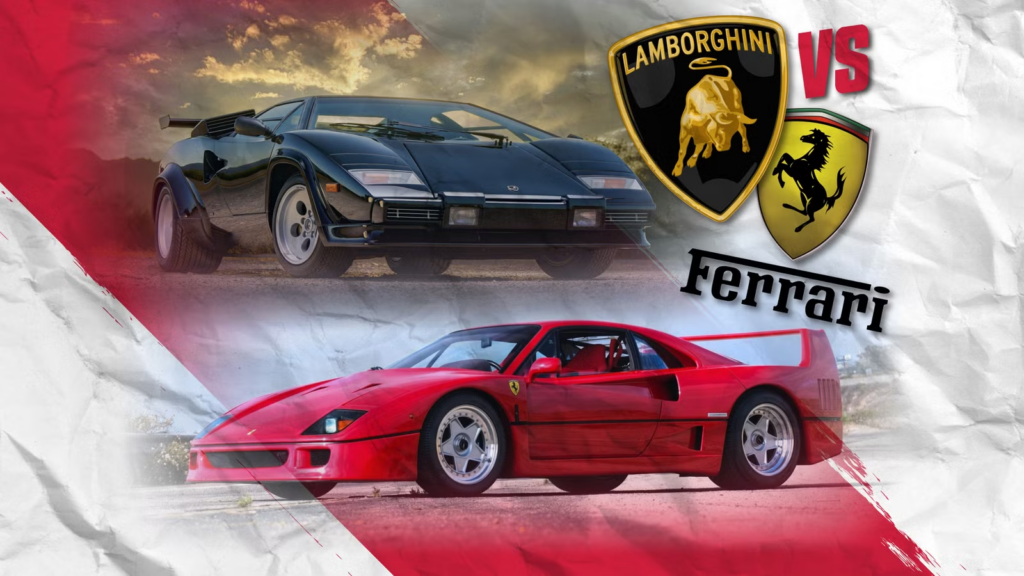
The seeds of conflict were sown in the early 1960s, when the successful industrialist and tractor magnate Ferruccio Lamborghini already owned several Ferraris. Unlike many wealthy enthusiasts who simply enjoyed the experience, Lamborghini possessed a deep understanding of mechanics and an equally deep sense of pride. He noticed an issue with the clutches in his Ferraris—a critical component that was experiencing persistent failures.
In the automotive culture of 1960s Italy, customer satisfaction was paramount. Lamborghini, confident in his engineering background, chose to approach Enzo Ferrari directly to report the issue and offer his insights for improvement.
The response he received cemented his resolve to build his own marque. Reportedly, Enzo Ferrari dismissed Lamborghini’s criticism with a stinging remark, suggesting that a tractor manufacturer wouldn’t understand the intricacies of racing cars. This dismissal—whether delivered verbatim or paraphrased—ignited a fire in Lamborghini’s belly.
This interaction did not merely sour a business relationship; it launched one of the most consequential rivalries in Lamborghini vs Ferrari automotive history. Ferruccio Lamborghini decided that if Ferrari wouldn’t meet his standards, he would build a car that not only surpassed Ferrari’s performance but did so with reliability, comfort, and a level of aggressive refinement that would challenge Enzo’s dominance.
In 1963, Automobili Lamborghini was founded with a singular vision: to build hypercars that combined brute force with exotic style, directly competing with the established king of Italian performance. This act of defiance was not just a business decision; it was a personal crusade.
The Initial Mission: Redefining the Supercar
Ferruccio’s objective wasn’t to create another race car; it was to manufacture a superior road car. He sought to inject luxury and refinement into the aggressive performance segment, an approach that would define the brand’s DNA.
By founding Lamborghini, Ferruccio didn’t just introduce a new player; he created a paradigm shift. He challenged the very definition of what a Ferrari car should be by proving that a luxury grand tourer could also possess savage acceleration and a distinctive visual identity. The battle for the hearts and minds of supercar enthusiasts began, but the war of engineering would take time to fully manifest.
The Miura vs. Daytona Epoch: The Defining Clash of the 1960s
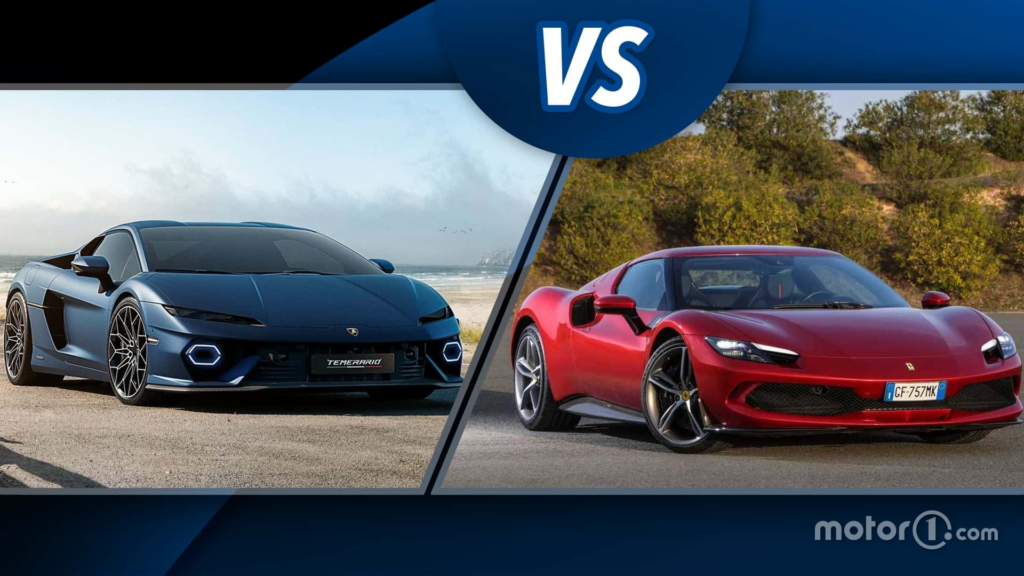
While the initial rivalry was conceptual, the first true collision of these marques occurred on the showroom floor in 1966. The arrival of the Lamborghini Miura was a watershed moment, not just for the rivalry but for the automotive world at large.
Lamborghini Miura: The First Mid-Engine Supercar
When the Lamborghini Miura was unveiled, it rewrote the rulebook. With its stunning Marcello Gandini design—low, wide, and featuring a revolutionary mid-engine layout—it was unlike anything the world had ever seen. The engine was positioned behind the driver and passenger, a feature traditionally reserved for pure race cars, which offered superior weight distribution and handling dynamics.
The Miura was more than just a car; it was a rolling revolution that showcased a future where exotic performance and aggressive styling went hand-in-hand. It established that Lamborghini Miura was not aiming for mere parity with Ferrari but for a dramatic redefinition of the segment.
Ferrari Daytona: The Traditionalist’s Response
Ferrari’s answer arrived in the form of the 365 GTB/4 Daytona. It was a masterpiece of Italian styling and power, yet fundamentally rooted in tradition. With its front-mounted engine and refined luxury appointments, the Daytona represented the pinnacle of the classic GT car architecture.
The Ferrari Daytona wasn’t just a competitor; it was a statement that Ferrari would not abandon its heritage of front-engined V12 grand tourers. However, the Miura had already set a new standard, forcing Ferrari to confront a new reality where its dominance was being seriously challenged by this upstart manufacturer.
Design Philosophies: Sharp Angles vs. Flowing Curves
The Lamborghini vs Ferrari debate often comes down to aesthetics. The visual divergence between these two marques has been a constant source of fascination and differentiation. While both produce visually stunning automobiles, their design languages reflect contrasting philosophies of automotive expression.
Lamborghini: The Vanguard of Radical Design
Lamborghini’s design philosophy, largely dictated by the legendary Marcello Gandini during the early years, is characterized by sharp angles, aggressive stances, and a focus on visual shock and awe. Cars like the Countach, Diablo, Aventador, and the current Huracán replacement have always embraced radical aesthetics.
Lamborghini’s design is about creating an immediate, visceral reaction. Their vehicles often feature scissor doors (Miura, Countach, Aventador, Revuelto), extreme aerodynamics, and a presence that commands attention on the street. They are designed to look as fast as they are, projecting an image of raw, untamed power and avant-garde futurism. When you see a Lamborghini, you know it is a Lamborghini.
Ferrari: The Embodiment of Elegant Aggression
In contrast, Ferrari’s design language, traditionally characterized by flowing lines, organic curves, and an elegant, sensual aggression, speaks to its racing heritage. Models from the 288 GTO and F40 through to the 12Cilindri Spider emphasize a more refined, sculptural approach.
Ferrari’s design is about conveying speed and performance through aerodynamic efficiency rather than pure aggression. These cars are often described as beautiful in a way that is more subtle and timeless than the dramatic flair of a Lamborghini. However, this elegance does not diminish their performance. Ferrari cars often appear faster just by looking at them—the lines suggest motion, the stance implies focus, and the result is a visual harmony that appeals to those who appreciate refined craftsmanship.
The Technical Showdown: Hybrid Evolution and Performance Battles
While the initial comparisons were drawn from early gasoline-only models, the Lamborghini vs Ferrari rivalry has evolved significantly in the 21st century, particularly with the advent of hybridization and the global shift towards electric mobility. Both companies are pushing the boundaries of performance technology, often utilizing hybrid systems to achieve unprecedented power levels while adhering to evolving emissions regulations.
The Technological Arms Race
Modern 2026 automotive innovation has transformed the rivalry into a high-tech battle. Ferrari continues to leverage hybrid technology to boost performance while maintaining its distinct sound and driving feel. Lamborghini, while often perceived as raw and mechanical, has also embraced hybrid powertrains to deliver exhilarating performance with slightly better efficiency.
When analyzing Ferrari performance vs Lamborghini in the context of modern hybrid technology, the data is impressive. Both brands are engaged in an intense technological arms race to deliver the fastest lap times, the most brutal acceleration, and the most advanced driving dynamics, but they do so using different engineering philosophies.
The Sound of Speed: Roaring V12s vs. High-Pitched Screams
One of the most contentious topics in the Lamborghini vs Ferrari debate is sound. To many enthusiasts, the soundtrack of a supercar is almost as important as its performance. Both marques have unique audio signatures derived from their different engine philosophies.
The Lamborghini Roar: A Primal Force
Lamborghini has long been renowned for the deep, guttural roars of its V10 and V12 engines. The howl of the Huracán or the thundering bellow of the Aventador is often described as primal and raw. It is a sound that fills the air, announcing the car’s presence long before it arrives.
The Ferrari Scream: The High-Pitched Opera
Ferrari’s V12 engines, on the other hand, typically produce a higher-pitched, more refined scream. This sound is often likened to an opera—a complex, layered symphony of mechanical notes that builds in intensity. While perhaps not as physically impactful as the Lamborghini roar, the Ferrari sound is considered by many to be more refined, evocative, and deeply connected to racing heritage.
The choice between these two auditory experiences often boils down to personal preference: the brute force of the Lamborghini roar or the sophisticated elegance of the Ferrari scream.
The Race-Track Dominance: Heritage vs. Street Focus
Historically, the