



The Raging Bull vs The Prancing Horse: A Deep Dive into the Lamborghini vs Ferrari Rivalry
The automotive landscape has long been defined by legendary rivalries, but perhaps none captures the imagination quite like the enduring saga of Lamborghini versus Ferrari. This isn’t merely a comparison of high-performance supercars; it is a clash of ideologies, a testament to pure human ego, unbridled style, and mechanical genius. Often described as a rivalry, the relationship between these two titans of Italian engineering transcends mere competition. It is a visceral battle born of pride, driven by innovation, and waged on the asphalt of global acclaim.
On one side stands Enzo Ferrari, a titan of the automotive world, whose name became synonymous with speed, precision, and the relentless pursuit of perfection. He was the architect of the Prancing Horse, a legend whose legacy is inextricably linked to the world of motorsport and Formula 1. On the other, we have Ferruccio Lamborghini, a successful agricultural equipment manufacturer whose own experiences with Ferrari’s machinery sparked a determination to create automobiles that offered a different kind of perfection—one that combined stunning aesthetics with raw, unadulterated power. This rivalry, known as the Lamborghini vs Ferrari war, did not just change the definition of what a supercar could be; it forever altered the trajectory of automotive history.
Ferruccio’s decision to enter the arena was not driven solely by a passion for speed or automotive perfection. It was born from a deeply personal slight, an insult that bruised his pride and ignited a fire within him. This is the story of how a tractor manufacturer decided to challenge the king of Italian sports cars, and in doing so, created a dynasty that has thrilled drivers for decades. This conflict is more than just a battle of man versus machine; it is a war of wills, a collision of automotive philosophies that continues to shape the industry today.
The Spark: How Ferruccio Lamborghini Challenged the Ferrari Empire
The genesis of this legendary rivalry is a narrative straight out of a Hollywood script. It begins in the early 1960s, a time when the world was hungry for speed, luxury, and performance. Ferruccio Lamborghini, already a successful entrepreneur with a reputation for mechanical ingenuity, found himself dissatisfied with the Ferraris he owned. While he admired their performance, he was increasingly frustrated with what he perceived as mechanical flaws, particularly in the clutches and gearbox. Like any Italian with a strong sense of pride and a talent for engineering, Ferruccio sought to address these issues directly with Enzo Ferrari.
Enzo Ferrari, a self-promoter and a man fiercely protective of his brand’s reputation, famously dismissed the complaints of the tractor magnate. The legendary anecdote recalls Enzo remarking, “You can drive a tractor, but you will never drive a Ferrari.” This dismissive retort served as the catalyst for one of the most iconic rivalries in automotive history.
Stung by the insult and offended by Enzo’s arrogance, Ferruccio decided that if Ferrari would not refine its own machines, he would build his own. The goal was not simply to produce a car that rivaled Ferrari in speed, but to create a vehicle that possessed a superior level of comfort, elegance, and attention to detail. In 1963, Automobili Lamborghini was founded, and with it, a challenge was issued to the throne of the undisputed king of the Italian automobile market.
Ferruccio’s vision was to build luxury performance street cars that merged cutting-edge technology with breathtaking design. He aimed to produce a range of vehicles that not only satisfied the demands of discerning drivers but also set new standards for automotive engineering and aesthetic appeal. This ambition would forever change the landscape of high-performance automotive manufacturing.
Lamborghini vs Ferrari: The Evolution of the Supercar
The world first witnessed the full scope of this rivalry in 1966 with the introduction of the Lamborghini Miura. This mid-engined, low-slung masterpiece was unlike anything the world had seen before. With its revolutionary design and performance, the Miura was not just a car; it was a rolling declaration of war. Ferrari responded with the Daytona, a fast and potent machine that still adhered to the traditional front-engine layout, symbolizing a commitment to tradition and racing heritage.
The Lamborghini Miura established a new standard for what a supercar could be. Its mid-engine layout became the benchmark for performance supercars, while its aggressive aesthetics set the tone for future generations of high-performance vehicles.
Clash of Design Philosophies: Sharp Angles vs. Sleek Curves
The debate between Lamborghini vs. Ferrari extends far beyond speed and horsepower; it is fundamentally a clash of design ideologies. Lamborghini’s design language is characterized by its sharp, angular lines, often described as radical or futuristic. Vehicles like the Countach, Aventador, and Huracán scream for attention, embodying a bold and unapologetic aesthetic. In contrast, Ferrari traditionally leans toward flowing lines and elegant aggression. From the 288 GTO to the F8 Tributo, Ferrari’s design philosophy prioritizes sleek dominance and aerodynamic efficiency.
Lamborghini: Shock and Awe
Ferrari: Grace and Aggression
From a design perspective, Lamborghini is the show-off, the flamboyant peacock of the automotive world. Ferrari, on the other hand, operates like a silent predator—elegant, controlled, and deadly effective.
The Race Track vs. The Street: Where They Compete
Though both brands have never directly competed head-to-head on the racetrack, their rivalry remains palpable. Ferrari has a deep-rooted legacy in Formula 1 racing, with a history of success and dominance that is unmatched in the world of motorsport. Meanwhile, Lamborghini has historically focused on manufacturing luxury performance street cars, creating vehicles that prioritize driving pleasure, power, and aesthetic appeal over competitive racing.
Fact: Ferrari dominates the track, and Lamborghini rules the streets.
This distinction has shaped the evolution of both brands, creating a clear separation in their target audience and market positioning. Ferrari is the choice of those who live and breathe racing, while Lamborghini appeals to those who desire raw power, bold design, and a sense of exclusivity.
Technological Innovations: V12 Roars and Carbon Fiber Wars
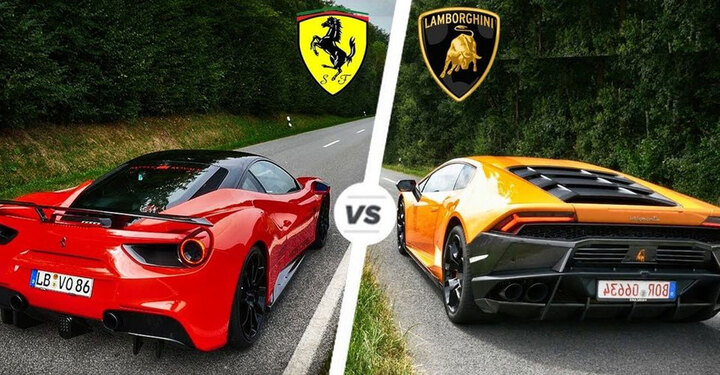
Both brands have always been at the forefront of automotive innovation, pushing the boundaries of what a car can achieve. Ferrari’s SF90 Stradale is a testament to this commitment, featuring a 1,000-horsepower plug-in hybrid system, advanced electronics, and racecar-inspired engineering. Lamborghini’s Revuelto combines a V12 engine with a hybrid system, delivering a level of performance and dramatic design that few other vehicles can match. The companies are in a perpetual arms race, with each striving to redefine the limits of speed, handling, and performance.
These technological advancements are not just about creating faster cars; they are about pushing the envelope of automotive engineering. Both brands are constantly exploring new technologies and materials to improve performance, efficiency, and driving experience.
The Soundtrack of a Rivalry: Who Sounds Better?
For car enthusiasts, the auditory experience of a supercar is as important as its performance. The roaring engines of Lamborghini’s V10 and V12 motors have become synonymous with raw power and aggression. The sound of a Huracán or Aventador is a primal cry, a symphony of mechanical fury that can be heard for miles. Ferrari, in contrast, offers a higher-pitched, more refined symphony, reminiscent of an opera. While loud, the Ferrari’s tone is more controlled and precise, a sound that commands respect and admiration.
Lamborghini’s sound waves shake the earth beneath you, while Ferrari’s roar is a stealthy predator, a silent assassin that strikes without warning. While some may prefer the aggressive roar of a Lamborghini, others are drawn to the refined precision of a Ferrari.
Evolution and Future: The Next Generation of Supercars
In the era of electric vehicles, both brands are adapting to changing market demands without sacrificing their core identity. Lamborghini is working on a new plug-in hybrid V12 successor to the Aventador and a hybrid replacement for the Huracán, while Ferrari is exploring electric powertrain options to meet the demands of sustainability.
Future Lamborghini Cars: The EV Journey
Lamborghini’s roadmap for the future includes a range of electrified vehicles designed to maintain the brand’s commitment to performance and design.
Revuelto PHEV V12: Expected to be a flagship model offering hybrid performance and cutting-edge technology.
Huracán Replacement (Hybrid): A new generation of performance cars with hybrid drivetrains.
Urus PHEV: An electrified version of their luxury SUV, designed for performance and sustainability.
Future Ferrari Cars: The Electric Revolution
Ferrari is also embracing electrification, with plans to launch its first fully electric supercar in late 2025.
12Cilindri Spider: A blend of traditional performance and modern technology.
SF90 Spider: A high-performance plug-in hybrid that showcases Ferrari’s expertise in performance engineering.
Ferrari EV (Expected Late 2025): A revolutionary electric supercar that promises to redefine performance.
Both brands are proving that sustainability doesn’t mean slow, and hybrid power doesn’t mean boring. They are committed to pushing the boundaries of what’s possible, ensuring that the Lamborghini vs Ferrari rivalry continues to evolve in the years to come.
Loyalty or Lifestyle: Which One Will You Drive?
Owning a Ferrari or Lamborghini is not as simple as making a purchase. Becoming part of these exclusive worlds requires proving one’s worth through loyalty and commitment to the brand. Ferrari, particularly with special models like the LaFerrari, often requires owners to demonstrate their dedication through a history of ownership. On