The New Hierarchy of Automotive Spectacle: Why Las Vegas Is Poised to Dethrone Pebble Beach in the Luxury Collector’s Market
In the rarefied atmosphere of international automotive gatherings, the term “Concours d’Elegance” once carried an almost sacrosanct weight. Traditionally defined as a competition where vehicles and accessories are judged primarily on their aesthetic brilliance and presentation, these events serve as the zenith of automotive artistry. For decades, enthusiasts, collectors, and marques alike have operated under a clear hierarchy: Pebble Beach reigned supreme. However, the landscape of collector car culture is undergoing a dramatic transformation, driven by evolving consumer tastes, shifts in automotive manufacturing, and the rising economics of access.
If you spend enough time immersed in the world of high-end automobiles, one question invariably arises: Is the legendary Pebble Beach Concours d’Elegance still the apex of the scene? For many, Pebble Beach is synonymous with the entire Monterey Car Week—a week-long, ultra-premium confluence of automotive extravaganzas culminating in the titular Sunday event. This period represents a global convergence of wealth and obsession focused on exquisite, multi-million-dollar machines, a spectacle that has long been considered the pinnacle of concours excellence. Yet, in recent years, comparisons have escalated. Is the Goodwood Festival of Speed superior? Does the Goodwood Revival offer more? What about Amelia Island, Moda Miami, or the Parisian Retromobile?
In every corner of the globe where affluent connoisseurs gather to admire blue-chip automobiles, the same question is asked. Here is the unvarnished truth: Pebble Beach retains its crown as the king of the traditional concours. However, the direct heir to its throne—The Quail, A Motorsports Gathering—has found itself facing a formidable new challenger.
The Erosion of Pebble’s Monopoly: Why The Quail’s Position Is Threatened
The Quail has historically been perceived as the perfect appetizer to Pebble Beach’s Sunday main course. Indeed, for a significant and growing segment of the automotive community, The Quail has long since eclipsed the Sunday event. This demographic tends to be intensely focused on cutting-edge, late-model supercars and hypercars. I have lost count of how many friends attend Car Week only to depart Sunday morning, expressing no interest in what they dismiss as “old cars.”
Furthermore, the dissolution of the Geneva International Auto Show has left a critical void in the supercar calendar, a void that The Quail has filled remarkably well. A few examples illustrate this phenomenon. The Lamborghini Aventador made its debut at Geneva in 2011, followed by the ultra-exclusive Veneno in 2013. The Aventador’s successor, the Revuelto, was unveiled online, but the Temerario (the Huracán’s replacement) made its official public debut at The Quail in 2024. Similarly, the seven-figure Fenomeno debuted at the 2025 Quail. While Bugatti unveiled the Chiron in Geneva back in 2016, the Bugatti Divo (2018) and the Mistral (2022) were both first presented to the world at The Quail. This trend extends to countless other models. In essence, The Quail has evolved into the premier global showcase for these cutting-edge automotive marvels.
Until this past Halloween, I believed The Quail’s position in the global automotive hierarchy was unassailable. Then, I attended the 2025 Las Vegas Concours (officially known as the Concours at Wynn Las Vegas), and I am no longer sure of its future. I should preface this by noting that I also attended the 2024 Vegas Concours and, while I enjoyed it, I found it somewhat provincial, featuring the usual suspects rather than breakthrough displays. In fact, had I not been working on a project with Czinger, I likely wouldn’t have attended this year. However, I am immensely glad that I did. The 2025 Concours at Wynn Las Vegas represents a fundamental shift in automotive showcasing that we simply cannot ignore.
What Exactly Is the Concours at Wynn Las Vegas?
The Las Vegas Concours is not merely another regional automotive event; it is an emerging global powerhouse that commands the attention of the most exclusive marques and discerning collectors. The organizers have leveraged Las Vegas’s unique infrastructure and strategic location to curate a spectacular experience that is redefining the Concours d’Elegance paradigm.
One of the most striking aspects of the 2025 event was the sheer density of automotive excellence. The Wynn unveiled 48 Bugatti Veyrons on the lawn—you read that correctly. Of the 450 total Veyrons ever manufactured, with only 100 sold in North America, 48 were present in Las Vegas. Well, 49, as Bugatti also brought a stunning white Vitesse Super Sport to commemorate the Veyron’s 20th anniversary. Accompanying this tribute were a Bolide, Centodieci, Chiron Super Sport, Divo, Mistral, and a prototype of the upcoming 18-cylinder hybrid Tourbillon, set to replace the Chiron. To assemble, in one location, more than 10 percent of all Bugatti Veyrons ever built is an achievement that leaves one breathless.
This commitment to featuring rare, multi-million-dollar hypercars extends to other iconic brands. The kids like Paganis, too, don’t they? Because there were more than 40 of them. I didn’t count the exact number (I was too busy drooling over the Veyrons), but there were several Zondas, including a Zonda Revolution (one of only five ever produced), dozens of Huayras, a cluster of Utopias, and—worryingly for The Quail—the official debut of the Huayra Codalunga Speedster. Pagani plans to produce only ten of these speedsters, with a retail price of approximately $7 million each before taxes and tariffs. For those interested, the mint-green model displayed under wraps belongs to Apple’s Tim Cook. Even if these carbo-titanium extroverts are not your preferred aesthetic, the fact that the 2025 Las Vegas Concours hosted not only the largest Pagani gathering ever assembled in North America but also featured Horatio Pagani himself—who was honored onstage by emcee Justin Bell for his lifetime contributions to automotive design—speaks volumes about the event’s emerging significance. More on that in a moment. Returning to the topic of the 40+ Paganis, this figure represents a larger quantity of cars than the manufacturer produces in an entire year.
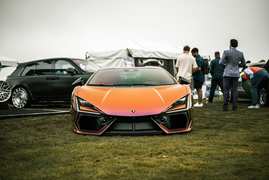
The Lamborghini section was equally astounding for those who appreciate such vehicles. The 2025 Wynn Vegas Concours hosted the largest gathering of Lamborghinis in history. Yes, in history. Again, I did not count, but the number being discussed was approximately 230. That equates to 230 of the 600 cars displayed on the lawn that Saturday. It is simply mind-blowing. Of these 230 models, the display included a Veneno Coupe (one of only three sold to the public; the factory retains a fourth), a Sesto Elemento (one of only ten), a Centenario Coupe (one of 20) and Convertible (also one of 20), and a Reventón (one of 21). The last time I witnessed all these “limited-production” supercars (as Lamborghini now refers to them) gathered together was at the factory museum. It was a breathtaking exhibition of precious, high-horsepower Italian metal and composites.
The Shifting Economics of Global Automotive Events
In an attempt to be concise, I have omitted all the Koenigseggs, the Gumpert Apollo, the Czingers, the Nilu, the McLaren Project Endurance race car debut, the cars that were actually judged (including a former and insane Pebble Beach Concours-winning 1929 Mercedes-Benz 680 S Barker Tourer 26/120/180 that also won pre-war best of show at this event), the HWA EVO, a Mercedes-AMG One, two Oldsmobile Aerotechs, and a McLaren F1. Ladies and gentlemen, that is one heck of a car show.
However, the significance of the 2025 Las Vegas Concours transcends the sheer volume of rare automobiles. It represents a fundamental disruption in the economic model of automotive events, potentially challenging the dominance of established venues. Two critical themes dominated the conversations among attendees at the Wynn Vegas Concours, raising questions about the sustainability and relevance of traditional events.
Question 1: How Can They Possibly Top This Next Year?
The primary question on everyone’s mind was, “How on earth are they going to top this next year?” The organizers have set an unprecedented standard, and the pressure to innovate and exceed expectations is immense. While the answer remains unknown, all we can do is wish the Wynn team the best of luck.
Question 2: Should We Even Bother Doing The Quail Next Year?
This second query, posed by OEM representatives, is far more intriguing and poses a serious existential question for The Quail. Good question, indeed. Perhaps we should also wish The Quail godspeed.
Let me elaborate on the financial aspects that are shifting the automotive landscape. A single ticket to The Quail cost $1,300 last year for returning attendees (referred to as “legacy ticket holders,” I believe). For first-time attendees, the cost was $1,600. While this is expensive, it costs original equipment manufacturers (OEMs) approximately $400,000 to