
The Audrain Concours d’Elegance: A Masterclass in Automotive Heritage
Donald Osborne, wearing his signature bowtie and a confident air that few could rival, posed a question that perfectly set the tone for the event. “What’s it going to take to get you out to the Audrain?” he asked, his Italian-infused voice carrying across the bustling Miami Yacht Club marina during the inaugural MODA exhibition.
Osborne, the spiritual leader and master of ceremonies for what has quickly become one of the most prestigious and discerning classic car events in the United States, was referring to the Audrain Concours d’Elegance. Held in the historic and impossibly elegant seaside city of Newport, Rhode Island, the Audrain is a place where automotive history converges with modern artistry, where mechanical engineering meets high-fashion, and where enthusiasts gather to celebrate the pinnacle of automotive design and performance.
As Osborne and I both found ourselves in Miami for the MODA event—an exhibition founded, I learned, out of spite after Hagerty’s Broad Arrow auction house poached nearly 30 of RM Sotheby’s best employees two years ago—I couldn’t resist asking Osborne if he’d make me a judge. He flashed a smile that would make the Mona Lisa jealous, waved a hand in my direction, and simply said, “You’re a judge. See you in Newport.”
Into the Deep End: Finding My Place in the World of Concours Judging
The first time I ever attended Pebble Beach Car Week—the undisputed granddaddy of all decadent, high-society classic car gatherings—I was absolutely green. This was well before the age of social media, before every event was live-streamed and hashtagged to oblivion. Back then, I knew little about the world of concours judging and had no idea such events even existed. I didn’t even know what to wear, naively assuming the big Sunday show was just a slightly larger version of a Cars & Coffee gathering. I believe I showed up in shorts and a T-shirt. However, I did notice something that planted a seed in my mind: a friend of mine, the Pulitzer Prize-winning automotive journalist Dan Neil, was an honorary judge.
That sight made a significant impression on me. It also stirred something in my ego. The thought popped into my head: “Why not me?”
While Pebble Beach may hold the crown as the world’s premier automotive concours, the Audrain is its closest contender. Many experts, including Jay Leno—who famously owns, to quote him, “a ridiculous house” in Newport—will tell you that the Audrain is arguably better than Pebble. I know this because during The Gathering event at Doris Duke’s incredible Newport “summer cottage” called Rough Point—Audrain’s answer to The Quail—Spike’s Car Radio, a podcast I co-host with Seinfeld writer Spike Feresten (inventor of “No soup for you!”), did a live show with special guest Jay Leno. He made the point that Audrain Motor Week reminds him of Pebble Beach 15 years ago. Leno is an essential and integral part of the Audrain; in fact, the mayor, via a official proclamation, declared October 2, 2025, to be Jay Leno Day in Newport.
How to Judge? Finding My Way in a World of Elite Competitors
So there I was, serving as a judge during the main event on Sunday. I was seated at the judges’ breakfast, enjoying coffee, eggs, and sausage, when the head judge, Phil Neff, looked around the room and asked, “Is there anyone here who hasn’t judged a concours?” Not a single hand went up, including mine.
Now, I had never judged a fancy-schmancy concours like the Audrain. But I have judged the parody car show, Concours d’LeMons, so many times that I have not only lost count but have also sworn to never do it again. Should I have raised my hand? Who knows, but ultimately, it’s about cars, right? How hard could it be? Remember, my ego is undefeated. Why not me?

Neff and his team paired me up with Ray Evernham, the legendary NASCAR Hall of Fame crew chief who won everything in the sport, often with driver Jeff Gordon. Evernham and I hit it off immediately, as we realized we had both raced at Pikes Peak. Our task was to hand out the Sporting Choice Award. Basically, we were looking for the most sporting car on the lawn. I asked head judge Neff for some clarification. Did he want us to focus more on sports cars, or actual race cars? “Yes,” he replied, smiling. This meant we were responsible for looking at and judging every car present that either had two doors or no doors. That’s well over 100 cars, and we only had two hours to do it.
Sporting our judge hats, medallions, clipboards, No. 2 pencils, and navy blazers, Evernham and I stepped onto the field and quickly came up with a plan. Like at all concours, the cars are broken up into classes. We’d simply look at each class, figure out one car that “popped,” and write down our top four or five favorites. Our instructions were not to get bogged down with typical nitpicky minutiae that plagues modern car judging. Who cares if the trunk lining is wrong? In fact, don’t even open the trunk.
Still Not Simple: Making Tough Calls in a Field of Legends
The first two classes made me quickly realize the answer to my earlier “Why not me?” fantasy. Class D consisted of Ford GT40 road cars—six cars that appeared nearly identical in quality GT40 Mk1 homologation specials. For real, all looked equally awesome, and without checking carb-bolt alignment (as we were instructed not to do), I have no idea how you’d pick a winner. We couldn’t. Put another way, the people judging Class D had to be real and serious subject matter experts to make this call.
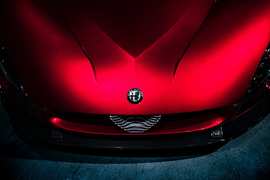
The same was true with Class A, the prewar Alfa Romeo division, which consisted of six mind-blowingly excellent 8Cs. I couldn’t even begin to tell you why the car that won its class did so, though the burgundy beauty did go on to win Best of Show, and somehow that part totally makes sense.
In any case, we still came up with a short list of our favorites, though sacrifices had to be made. There was a Lamborghini 3500 GTZ Zagato Coupe that blew my mind because I’d never heard of it before (it turns out only two were ever built, and the other one is being purposely kept away from the public). However, I realized that as novel and “Wow!” as I thought the Zagato Lambo was, it wasn’t winning the Sporting Choice Award. For his part, Evernham was super into an exceedingly rare Allard JR that raced at the 1952 24 Hours of Le Mans. However, I quickly discovered he owns three Allards, and we ought to strike this JR off our list. Sweet car, however. Fitted with a Jaguar C-Type body to comply with new Le Mans regulations but still powered by a 5.3-liter Cadillac V-8, it remains the most successful of the seven Allard JRs built.
The Hardest Choice: Honoring Two Exceptional Vehicles
The hardest choice we had to make was for third place. It was between a 1949 Alfa Romeo 6C 2500 SS Touring Superleggera Coupe and a 1940 Cadillac Series 62 Bonham & Schwartz Convertible Victoria. I’m a sucker and a fiend for postwar Alfas. I don’t know exactly what it is, but I just love them to pieces. I suppose it’s mostly the Bakelite used on all the switchgear. This particular 6C was finished in a handsome blue and had a great backstory, including the fact its present owner hadn’t driven it since 1973 until the day before the Concours d’Elegance, on the Audrain Tour d’Elegance.
However, we found the Caddy more sporting. It was one of two, custom-bodied in Pasadena, California, by the same folks (Bonham & Schwartz) who did Clark Gable’s Duesenberg; the candy-red Series 62 just popped. It had that wow factor, the know-it-when-you-see-it, that extra something special. One of two made, yes, but the only survivor, as its sibling burned up in a fire. This car was built for a wealthy Californian oil baron family, the Doheny clan, that just happened to be the founders of a little town called Beverly Hills. We awarded the car our third-place vote, or in Audrain-speak, Honorable Mention.
The Final Call: A Tale of Elegance and Innovation
For us, the Sporting Choice Award came down to two cars: an oligarchical 1938 Talbot-Lago T150 C Lago Figoni et Falaschi Teardrop Coupe and a light green 1951 Cisitalia 202SC Pinin Farina Cabriolet. The Talbot “Goutte d’Eau” certainly had the provenance to win. Aside from being the only long-wheelbase T150 C ever built (15 regular wheelbase versions were made), this particular car holds a racing record that will never be broken: Built in 1938, this T150 C won the Belgian Grand Prix at Spa in 1948, making it the oldest car to ever