
The Audrain Concours d’Elegance 2026: Navigating the Intersection of Automotive History and Modern Value
The invitation arrived with characteristic Audrain fanfare: a digital missive delivered with the polish of their prestigious events, even down to the signature tone of its spiritual advisor, the bowtie-wearing, Italian-speaking master of ceremonies, Donald Osborne. “What’s it going to take to get you out to the Audrain?” he’d inquired, not without a hint of charm-laced insistence, during our recent encounter in Miami at MODA—the RM Sotheby’s initiative born out of what many perceived as necessity rather than pure innovation, especially considering the exodus of talent from Hagerty’s Broad Arrow that preceded it.
For years, the Audrain Concours d’Elegance had been on my radar. Founded in 2019, it rapidly positioned itself as a formidable competitor to the venerable Amelia Island Concours d’Elegance, an institution that Hagerty ultimately acquired. Now, after years of nudging, I found myself on the hallowed ground of Newport, Rhode Island, a city steeped in the gilded age and seemingly custom-built for the aesthetic of serious automotive artistry.
Stepping into the Miami heat, I turned to Osborne and pitched an idea that had long been brewing: “Make me a judge?” His response was swift and delivered with a charismatic sweep of the hand. “You’re a judge. See you in Newport.” It was the kind of decisive endorsement that signals entry into an exclusive world, one I’d observed from afar but never truly inhabited at this level.
Into the Deep End: First Impressions of a Concours Veteran
My first real immersion into the rarefied world of classic car judging wasn’t at Audrain, but at Pebble Beach. It feels like a lifetime ago, a period long before the pervasive influence of social media dictated how we experienced, and often manufactured, these moments. I was decidedly green, lacking even the basic sartorial knowledge one expects at such a high-profile event. I naïvely assumed the main competition on Sunday was merely an upscale ‘Cars and Coffee’ affair, and I likely arrived in shorts and a T-shirt—an egregious fashion faux pas by any professional standard.
What I did observe, however, was the presence of Dan Neil, a Pulitzer Prize-winning automotive journalist, serving as an honorary judge. It struck me as a rather prestigious appointment. In that moment, a thought—driven by an ego that has, at least in my own mind, yet to face a true defeat—took root. Why not me?
Now, let’s be clear: The Audrain is not Pebble Beach, and many in the community would tell you it’s actually superior. I recall a conversation with Jay Leno during The Gathering—Audrain’s answer to The Quail, hosted at the spectacular Doris Duke estate known as Rough Point. As host of Spike’s Car Radio, alongside comedian and writer Spike Feresten (the aforementioned inventor of “No soup for you!”), we sat down with Leno. He articulated a sentiment that resonated deeply with the atmosphere of the event: Audrain Motor Week reminds him of Pebble Beach fifteen years ago. Leno, who owns what he jokingly refers to as “a ridiculous house” in Newport, is not merely a guest but a fundamental fixture of the Audrain. The city even dedicated a day to him in 2025, proclaiming October 2nd as Jay Leno Day.
The Science of Judging: Establishing Criteria in an Unruly Arena
So, here I was, stepping into the actual competition on Sunday. The day began with a breakfast featuring coffee, eggs, and sausage, setting the stage for the serious business ahead. Phil Neff, the head judge, posed a fundamental question to the assembled group. “Is there anyone here who hasn’t judged a concours?”
Silence. Not a hand was raised, including mine.
While I had never judged a formally prestigious event like Audrain, I had extensive experience at the parody competition, Concours d’LeMons. I’ve judged so many times that I’ve not only lost count, but I’ve also sworn to never participate again. Should I have admitted my lack of formal experience? Perhaps. But this is cars, isn’t it? How difficult could it be? (Again, recall: Why not me?)
Neff and his team paired me with Ray Evernham, the NASCAR Hall of Fame crew chief whose legendary career includes multiple championships, most notably during his partnership with Jeff Gordon. Evernham and I hit it off instantly. We discovered a shared passion for Pikes Peak and were assigned the task of awarding the Sporting Choice Award—a designation focused on identifying the most dynamic, driver-focused cars on the field.
I sought clarification from Neff. Were we looking for traditional sports cars, or actual race cars? “Yes,” he replied with a smile. This translated to a mandate: we were to review and judge every car on the field that featured either two doors or no doors. That encompassed a significant portion of the inventory—well over 100 vehicles—and we had only two hours to complete the assessment.

Sporting our official accoutrements—medallions, clipboards, No. 2 pencils, and navy blazers—Evernham and I stepped onto the field and quickly devised a strategy. Like at most concours, the cars are organized into distinct classes. Our plan was to review each class, identify the standout vehicle, and compile a list of our top four or five choices. The instructions were explicit: avoid the typically nitpicky details that plague modern car judging. “Who cares if the trunk lining is wrong? In fact, don’t even open the trunk.” These were the guardrails we were given.
Still Not Simple: When Criteria Become Subjective Dilemmas
The initial review process illuminated why this task demands true expertise. Two classes immediately demonstrated the difficulty of the assignment.
Class D was comprised entirely of Ford GT40 road cars. I estimated about six examples, all nearly identical in quality to the homologation special GT40 Mk1s. They were all stunning, and without scrutinizing carb-bolt alignment—which we were specifically told not to do—it was nearly impossible to single out a winner. We couldn’t pick just one. This is the reality of these high-level events: the people judging Class D needed to be genuine subject matter experts to make such a difficult call.
The same held true for Class A, the Prewar Alfa Romeo division. This class featured six mind-blowingly exquisite 8Cs. I couldn’t even begin to tell you why the specific car that won Best of Show triumphed. However, the burgundy beauty did go on to secure the overall prize, and somehow, that outcome felt entirely appropriate.
Despite the challenges, we did manage to assemble a short list of favorites. Sacrifices had to be made. I was immediately drawn to a Lamborghini 3500 GTZ Zagato Coupe—a model I had never encountered before (it turns out only two were ever built, and the other is intentionally kept from public viewing). However, as novel and visually striking as I found the Zagato Lambo, it simply wasn’t the sporting choice. Ray Evernham, for his part, was extremely enthusiastic about an exceptionally rare Allard JR that had actually raced at the 1952 24 Hours of Le Mans. Upon closer inspection, however, I realized Evernham owned three Allards, and it was prudent to strike this particular JR from our list. Still, it was a magnificent car: fitted with a Jaguar C-Type body to comply with new Le Mans regulations, it retained its 5.3-liter Cadillac V-8 engine, making it the most successful of the seven Allard JRs ever built.
The Hardest Choice: Postwar Beauty vs. Road-Ready Power
The most challenging decision we faced was choosing the third-place selection. We had narrowed it down to two finalists: a 1949 Alfa Romeo 6C 2500 SS Touring Superleggera Coupe and a 1940 Cadillac Series 62 Bonham & Schwartz Convertible Victoria.
I am an absolute fiend for postwar Alfas. I cannot explain the attraction exactly, but I adore them to pieces. Part of it must be the Bakelite used on the switchgear, but there’s something else too—a certain refined elegance that makes them unforgettable. This particular 6C was finished in a handsome blue and possessed a remarkable backstory, most notably that its current owner had not driven it since 1973 until the day before the Concours d’Elegance, during the Audrain Tour d’Elegance. It had recently been recommissioned and returned to the road just in time.
However, we ultimately found the Cadillac to be the more sporting choice. It was one of only two ever built, custom-bodied in Pasadena, California, by Bonham & Schwartz—the same firm that created the Duesenberg for Clark Gable. This candy-red Series 62 just popped. It possessed that ‘know-it-when-you-see-it’ factor, that extra layer of wow that separates good cars from great ones. While it was one of two manufactured, it remains the sole survivor, as its sibling was tragically destroyed in a fire. This particular automobile was built for the wealthy Californian oil baron family, the Doheny clan, who just happened to found a little town called Beverly Hills. We awarded the car our third-place vote—or, in Audrain-speak, Honorable Mention.
The Final Call: Deciding Between Provenance and Emotion
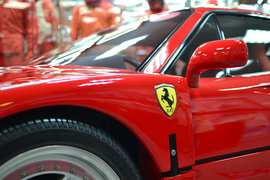
Our decision for the Sporting Choice Award